


The magnificent Fabric Synagogue în Timișoara, Romania îs — finally — under restoration after decades of neglect. Designed by the prolific Hungarian synagogue architect Lipót Baumhorn, it was built between 1897 and 1899. In this Have Your Say personal essay, Anna Szentgyörgyi, who has been involved in recent efforts to draw attention to the building and support its preservation, describes developments over the past few years and reflects on the impact of international cooperation and local commitment .
From “Sad Grandeur” to New Hope: The Revival of Timișoara’s Fabric Synagogue
By Anna Szentgyörgyi
March 25, 2026
The story of the Fabric Synagogue in Timișoara shows how international cooperation, local commitment, and growing awareness can gradually change the fate of a neglected heritage site.
Between 2018 and 2021, the Interreg Danube Transnational project REDISCOVER, led by the Municipality of Szeged, worked closely with Jewish communities across the region to explore and raise awareness of both the tangible and intangible aspects of Jewish heritage.
Within the framework of this project, we visited Timișoara in the spring of 2020. Our hosts were the Municipality of Timișoara project partner and members of the local Jewish community. The visit coincided with the 160th anniversary of the birth of the renowned synagogue architect Lipót Baumhorn, whose work shaped numerous synagogue buildings throughout Central and Eastern Europe.
During the visit we saw the Fabric Synagogue in the historic Fabric district and were struck by its condition. The once impressive building stood in a state of severe deterioration. Recognizing the urgency of the situation, we sought to draw wider international attention to this remarkable but endangered piece of Jewish architectural heritage.

(At the time, we shared our impressions in a Have Your Say essay for Jewish Heritage Europe describing the synagogue’s “sad grandeur.”)
International recognition and a turning point
Although the REDISCOVER project ended in 2021, the professional connections built during the project continued to have an impact. Through contacts established by the lead partner with the World Monuments Fund, the local Jewish community submitted an application to the World Monuments Watch programme.
In 2022 the Fabric Synagogue was included on the WMF’s Watch list, placing it among the 25 most endangered cultural heritage sites in the world that year and drawing international attention to the urgent need to safeguard the building.
Within the framework of the World Monuments Watch 2024 initiative, the synagogue was further identified as a site at risk of losing its historical integrity. Therefore, a number of public events were organized to help people engage with the history of the synagogue and with Jewish heritage in the city, including guided tours, workshops and discussions.
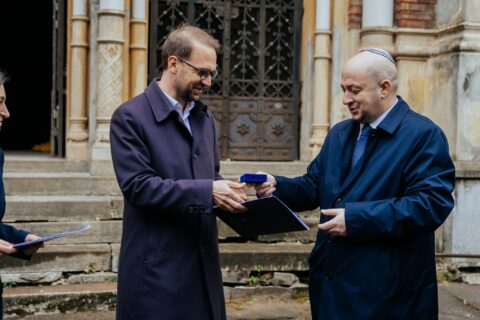
Important institutional steps also took place. In October 2023 the Municipality of Timișoara took over the administration of the synagogue for a period of 49 years. A year later, in October 2024, the municipality signed a Memorandum of Understanding with the World Monuments Fund, which committed to providing the design brief and technical requirements for the building’s adaptive reuse.
By the end of 2024 work had already begun to secure the structure, and an architectural office was commissioned by the World Monuments Fund to develop the professional framework for the synagogue’s future transformation.
In the spring of 2025 a series of consultative workshops brought together representatives of cultural and educational institutions, NGOs, business and public administration, members of the Jewish community and residents of the Fabric neighborhood, as well as civic organizations and experts in architecture and urban planning. These discussions helped shape a shared vision for the building’s future.
The plan is for the Fabric Synagogue to become a multifunctional public space — serving as a community center, youth educational hub and exhibition venue while respecting the historical identity of the building.

A new chapter: People Powered Tourism and the Fabric pilot area
A new chapter of international cooperation began in 2025, when the Municipality of Szeged once again assumed the role of lead partner in another Interreg Danube project, People Powered Tourism (2025-2028). Timișoara is again represented in the partnership, this time through its Destination Management Organization.
Within the project, the Fabric neighborhood has been selected as Timișoara’s urban pilot area, and the Fabric Synagogue plays an important role in this local development focus.
During the project’s partner meeting held in February 2026, the international partnership had the opportunity to visit the site and see first-hand the progress that has been made since the difficult conditions we documented during the REDISCOVER project.
The visit also highlighted the connection with the SHIFT initiative launched in 2025 by the Timișoara partner, which promotes innovative and community-driven approaches to urban development. SHIFT is an acronym for “The Synagogue’s History as Inspiration for Fabric’s Transformation.”
As part of the project, an art initiative installed colorful paintings on panels covering the synagogue windows “to draw public attention to the synagogue’s value, stimulate community involvement, and support rehabilitation efforts, turning it into a cultural and tourist landmark.”
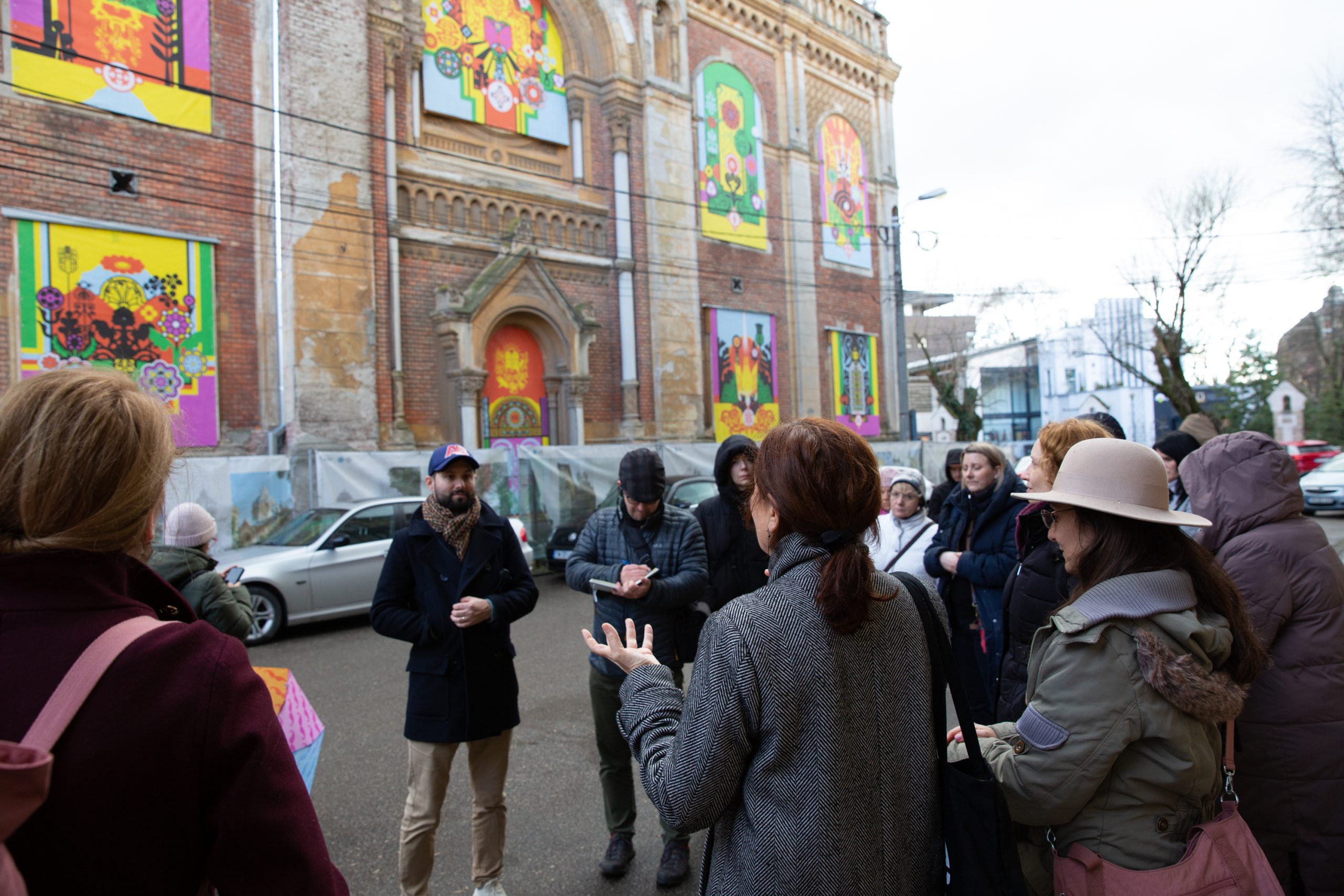
Together, these initiatives show how heritage preservation, participatory planning and sustainable tourism development can complement and reinforce each other.
Continuity in cooperation
The story of the Fabric Synagogue illustrates the long-term impact that transnational cooperation can have. What began as an effort to raise awareness about a neglected heritage site within the REDISCOVER project has gradually developed into an internationally supported process of rehabilitation and adaptive reuse.
Today, within the framework of the People Powered Tourism project, the synagogue stands not only as an important symbol of the shared Jewish heritage of the Danube Region, but also as a potential catalyst for community-based regeneration in the Fabric district.
Our recent visit reaffirmed an important lesson: safeguarding cultural heritage is not only about preserving historic buildings. It is also about empowering communities, strengthening identity and creating inclusive public spaces for future generations.
– – – – – –
Anna Szentgyörgyi is head of the Cultural Group at the Department of Culture, City Council Szeged, Hungary. She holds an MA degree in Cultural Mediation. She was deeply involved in rediscovering and promoting Jewish Cultural Heritage in the Danube Region as project manager of the REDICOVER Interreg project. For her work, she was awarded the Lipót Löw Prize by the Szeged Jewish Community in 2020. She is currently the communication manager of another Interreg project named People Powered Tourism, also lead by the Municipality of Szeged, Hungary.