

More than 200 Jewish cemeteries survive in Lithuania, many of them in far-flung towns and villages and most in neglected condition. Founded in 2011, the NGO Maceva, the Litvak Cemetery Catalogue, works to document, clean, digitize, and restore them.
In this Jewish Cemeteries Long(er) read, Maceva’s founder Sergey Kanovich and Director Milda Jakulytė report on how 2024 has seen significant progress in the NGO’s efforts. They pay tribute to the dedicated supporters and volunteers who made this possible and look forward to projects planned for the coming year. (The cover photo shows a volunteer in the Jewish cemetery in Adutiškis.)
With a big help from our friends, Maceva moved forward to preserve and document Jewish cemeteries in Lithuania
By Sergey Kanovich and Milda Jakulytė
December 17, 2024
As 2024 comes to a close, we look back at the progress we made this year in documenting and preserving Jewish cemeteries across Lithuania.
Unfortunately, the status of Jewish cemeteries in Lithuania remains precarious. Despite occasional maintenance by local authorities, including minimal cutting back of vegetation, most cemeteries remain neglected. Many are at risk of being entirely forgotten.
This lends all the more importance to every cemetery – large or small – that is cleaned, documented, and digitally preserved. Each cemetery we care for plays a key role in preserving the legacy of Lithuania’s Jewish heritage for future generations.
We did a lot this year – and it is a pleasure and a privilege to pay tribute to the generous support from both private and institutional donors, and to the dedicated work of our volunteers — that has enabled us to make important strides in ensuring that the memory of Lithuania’s Jewish communities is not forgotten.

We are especially grateful to the U.S. Embassy in Lithuania, which organized the cleaning of the Turgeliai Jewish cemetery this year.
Additionally, the Good Will Foundation has been instrumental in funding the documentation and translation of epitaphs of the Jewish cemeteries in Lithuania, a vital project for ensuring the preservation of these sites. The GWF is a Public Foundation whose goal is to distribute funds provided by the Lithuanian Government for the religious, cultural, health care, sports, educational and scientific goals pursued in Lithuania by Lithuanian Jews in a transparent, fair and effective manner.
A special mention must go to the Jewish descendants from the towns of Anykščiai and Adutiškis, whose generous donations made the documentation of their ancestors’ cemeteries possible. Their commitment to preserving the history of their communities is deeply appreciated.
This year, we have successfully documented more than a dozen Jewish cemeteries. While some are still awaiting the translation of their epitaphs, we are committed to completing this work as soon as possible.
In this regard, we would like to express our heartfelt thanks to Joel Suldan, our volunteer translator from the USA, who has provided his expertise to translate the epitaphs of the Old Jewish cemetery in Žemaičių Naumiestis, in western Lithuania near Klaipeda, ensuring that these important inscriptions can be shared with a wider audience. The cemetery dates from latter part of the 19th century and includes more than 370 gravestones; a newer Jewish cemetery in the town was completed razed.
Our special thanks also go to Avishai Lubitch from Tel Aviv, who has been translating epitaphs for us for many years.
The cemeteries whose epitaphs he translated this year include those in Anykščiai, Kriukai, Vilijampolė, Paberžė, Veiviržėnai, Ariogala, Nemunaitis, Sudargas, Pilviškiai, Druskininkai, Dūkštas, Marijampolė, and Kuršėnai. Each cemetery tells its own unique story, and documenting them ensures that their histories will not be lost.
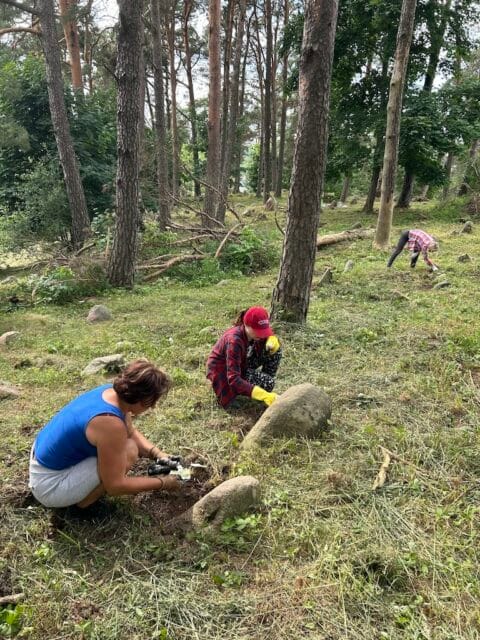
We also want to acknowledge the invaluable contributions of volunteers in the documentation process. The work of the Maceva volunteers has been crucial in documenting the Anykščiai Jewish cemetery, and we are deeply grateful for their ongoing support.
We would like to give specific recognition to the involvement of Jūratė Musteikienė, a history and civics teacher from the Jonas Biliūnas secondary school in Anykščiai, and her students, who, alongside their other volunteer activities (such as weaving nets for Ukraine), dedicated their time to documenting the Jewish heritage of Anykščiai.
In addition, we need to highlight the significant contributions to the documentation of the older of the two Jewish cemeteries in Vištytis, in southwestern Lithuania on the border with the Kaliningrad area of Russia.
The Vištytis old Jewish cemetery, which sits on the border with Russia, was cleaned by local authorities this year, and we documented 70 surviving matzevot. We were also involved in the documentation of the new Jewish cemetery in Vistytis in 2019.
We are especially grateful to Ralph Salinger, a dedicated advocate for the preservation of Jewish heritage in the Vilkaviškis region of southern Lithuania, who traveled from Israel to assist with the documentation of the Vištytis cemetery. Joining him was Michael Leiserowitz from Warsaw, who with his wife heads a multi-faceted project on the history and culture of Jews in former East Prussia – an area that now comprises the Kaliningrad region and parts of northern Poland.
Their expertise and dedication have been invaluable in ensuring that the history of the Vištytis Jewish community is preserved.
Looking ahead, we have ambitious plans for the coming year. Maceva will continue its mission to preserve Lithuania’s remaining Jewish cemeteries. At the same time , however, we will try to expand our focus to encompass the history of shtetls as well as other remaining material heritage assets. Stay tuned!

One of the largest projects on our agenda is the cleaning and documentation of the Jewish cemeteries in Joniškis, Darbėnai, and Antalieptė. Also, we will be continuing to document the Jewish cemetery in Adutiškis.
Thanks to a generous donation from the Marshall family, which traces its roots to Varena, the Jewish cemetery of Varena will be documented and fenced to its original status.
We look forward to welcoming volunteers to assist with this project next summer, and also are seeking further funding to support the work. We are happy to say that our long standing relationship with volunteers from the German NGO Aktion Sühnezeichen (Action Reconciliation) will continue next summer in Joniskis.
We firmly believe that with the continued support of our friends and partners, we can help preserve these last material witnesses to the Litvak presence and way of life in Lithuania.
Each cemetery we document, and each epitaph we preserve, plays an important part in ensuring that the legacy of Lithuania’s Jewish communities is remembered and honored for generations to come.
For more information on these projects or to get involved, please visit https://www.litvak-cemetery.info.
– – – – –
Sergey Kanovich is the founder of Maceva. Milda Jakulytė is the NGO’s Director.