

This Long(er) Read takes you somewhat off geographical topic — to Latin America…JHE Contributor Michele Migliori recently spent a month in Ecuador. There he took time to visit and report on the Andean country’s Jewish cemeteries, which bear stone witness to the history and fairly recent European origins of the Jewish community. Michele has researched this topic, completing his Master’s Degree at Budapest’s ELTE university with a thesis titled The Forgotten Emigration: European Jewish Refugees in Ecuador and Colombia. Bordered by Colombia on the north, Peru on the south and the Pacific Ocean on the west, Ecuador, which today has a population of 16 million, between 1933 and 1950 granted asylum to as many as 4,000 European Jews who were first escaping from Nazi and Fascist Europe, and then from the horrors of the Holocaust and its aftermath. In Ecuador, Michele writes, and as we noted about the Americas in general in a Photo Essay post in October 2019, epitaphs and gravestones tell dramatic stories of emigration.
Ecuador: (European) Jewish heritage in an “unknown country”
By Michele Migliori
April 1, 2020
Ecuador was an “unknown country” for most of the Jews who moved there from Europe, so much so that the US-based film writer and producer Eva Zelig gave the title “An Unknown Country” to her 2015 independent documentary film dedicated to the story and history of the Jews who immigrated to Ecuador before and right after World War II, to underscore how distant was this country from those immigrants’ homes and imagination.
At the same time, Jews themselves were “unknown” to Ecuadorians at that time.
Until 1906, the Ecuadorian Constitution declared Roman Catholicism as the only religion of the state. Therefore, in order to immigrate to the country and acquire citizenship, being Catholic was a main requisite. It was only after 1914, when the Panama Canal was inaugurated, that Ecuador began witnessing European immigration on a large scale. According to the government’s official data, only four Jewish families were living in Ecuador in 1904. Even in 1917, a total of only 14 people of Jewish religion were known to be living in the country.
According to the Israeli historian Haim Avni, between 1933 and 1945, Ecuador hosted 3.200 European Jewish refugees, mostly coming from Germany, Austria, Czechoslovakia, and Italy. By 1950, this number had grown to around 4.000, mostly thanks to Jews who survived the Holocaust and were resettled to Ecuador; some of whom had family members already living there.
Watch the trailer to Zelig’s film:
The majority of these immigrants settled in in Quito, the capital city, and Guayaquil, the main port and economic focal point of the country. However, Jewish communities were also present in other cities, including Ambato, Cuenca, and Riobamba.
After 1950, most of the Jewish refugees who had first arrived in Ecuador relocated to the US, Canada, and Israel. Today, it is estimated that the Ecuadorian Jewish community amounts to around 600 members.
That means that even today, Jewish heritage sites and monuments in Ecuador, as well as this 20th century history, are largely unknown and sometimes forgotten; nonetheless, they are part of the national heritage and, in a broader sense, to Latin American heritage, cultural background, and economic development.
I wanted to see what was there; to see what is left of the built heritage connected with the Jewish migration in the country — and how it is remembered.
So, I started traveling around the country, meeting people and visiting Jewish heritage sites. By the end of my trip, I had visited three Jewish cemeteries and two synagogues in three cities: Quito, Guayaquil and Cuenca.
QUITO
The Jewish cemetery of Quito lies on one of the main (and most congested) avenues of the city: Avenida Eloy Alfaro. It is officially part of the municipal cemetery of El Batán. Its separate entrance is made out of wrought iron and has two stars of David on the top. Inside, the ceremonial hall stands next to a memorial to Holocaust victims. (See featured picture above.) The memorial, surrounded by palm trees, is composed of two concrete walls with the names of the concentration camps and blessings on the external part, while on the internal side there are hollows where candles or pebbles can be placed.

The cemetery was established right after the first Jews escaping Fascist Europe settled in Quito, and the oldest gravestones date back to the 1930s. (In 1984, some tombstones inside the cemetery were transferred by the Quito Jewish community from Ambato, a city located 160 kilometers south of Quito.) Today it is very well maintained by the gardeners hired by the Jewish community.
Most of the tombstones are written in Spanish, and it’s fascinating to see that sometimes even the names are translated into Spanish (Gunther became Gonzalo, Henrik became Enrique, Oswald became Osvaldo, and so on). Some epitaphs, however, are written in the language spoken by the person deceased, especially Italian and German, but also English and Russian. One can also find “in memoriam” inscriptions commemorating family members who didn’t survive the Shoah.

Among those buried here we can find notable figures — Jewish refugees who arrived in the country with nothing but hope and contributed to the country´s growth and development. They include:
Olga Fisch, a Hungarian Jewish refugee who fled to Ecuador in the second half of the 1930s and who founded a famous and successful fashion company that combines European and Indigenous traits.

Kurt Dorfzaun, a German Jew who arrived in Ecuador in 1945 and started working with his uncle in his small Panama hat factory, which today is one of the biggest and best-known hatmakers the country.
Alberto Di Capua Ascoli, an Italian Jew who along with other Italian Jewish refugees founded Ecuador’s first pharmaceutical company, LIFE, which still today is a leading firm in this field.
Members of the Kywi family, owners of the country’s biggest hardware store chain, can be found in the cemetery, as well as other prominent families that developed successful businesses in Ecuador over the last decades.
Among the Jews who arrived in Ecuador after WWII, the painter and sculptor Trude Sojka is without a doubt the bestknown. Born in Berlin in 1909 of Czech parents, Trude grew up in Prague and was deported to Terezin and in 1944 to Auschwitz.
Trude lost both her husband and newborn daughter in the Shoah. She arrived in Ecuador thanks to her brother who had already been living there. She started a new life, started a new family, and began to paint again.
Trude never spoke about the Holocaust except through her art. She used recycled materials (such as broken glass and auto parts) and cement to make her paintings; her work is exhibited both in Ecuador and around the world, including in the memorial museum of the Terezin concentration camp in Czech Republic. Her works are a clear evolution of her emotions, passing through her suffering as a victim of the Holocaust, to her acceptance and forgiveness. One of her first works depicts herself with the child she lost. She passed away in 2007, aged 97, and she rests together with her husband in the Jewish cemetery of Quito.
In 2009, the house in Quito where Trude and her family lived became a Cultural Center, managed by Trude’s daughter and granddaughter, where some 300 of her works are displayed. The Trude Sojka Cultural House serves as a memorial to the Holocaust via the arts, the life story of a family, and a place for reflection. Here, even in Ecuador, one can see how the horrors of the Holocaust left their impact: the family built a bunker in the back part of the house, in case they might need it.
Quito’s synagogue and the Jewish community headquarters, inaugurated in 2000, stand in the city’s northern Carcelén district. The white, modernist-like domed synagogue can host approximately 300 people. Its internal decoration features stained glass windows and a decorated dome, the work of an Israeli painter hired by the community. On the first floor stands the women’s gallery, and a beit midrash with wooden furniture that hosts daily prayers. The complex is surrounded by walls and barbed wire, controlled 24 hours a day.
GUAYAQUIL
The seaport of Guayaquil is Ecuador’s biggest and most densely populated city, as well as the country’s driving economic hub. As a seaport, it was the first place many European Jewish refugees arrived. Accounts show that many had a hard time adjusting – to the tropical weather, to the language – and had difficulty integrating into society.
The city has two Jewish cemeteries: the “old” one located inside the monumental municipal cemetery, and the modern and active one, in the so-called Peace Park (Parque de la Paz).
The old Jewish cemetery is divided into three sections and is located up on a hill. Its hundreds of tombstones are inscribed in different languages, showing the diverse origins of the European Jewish refugees buried there. Unlike in Quito, in Guayaquil only a few tombstones are written in Spanish – and the Spanish used sometimes shows spelling errors.

The languages I found walking through the tombstones include Hebrew, German, French, English, Italian, and Romanian; and there are hundreds of different places of birth of those buried, coming from dozens of countries, from Lithuania to Yugoslavia; from Bulgaria to Hungary.
Also, in contrast to Quito’s Jewish cemetery, the conditions of Guayaquil’s old Jewish cemetery are quite poor, with widespread dust and broken gravestones. The vast majority of the tombstones are more modest and less decorated than the ones in Quito.
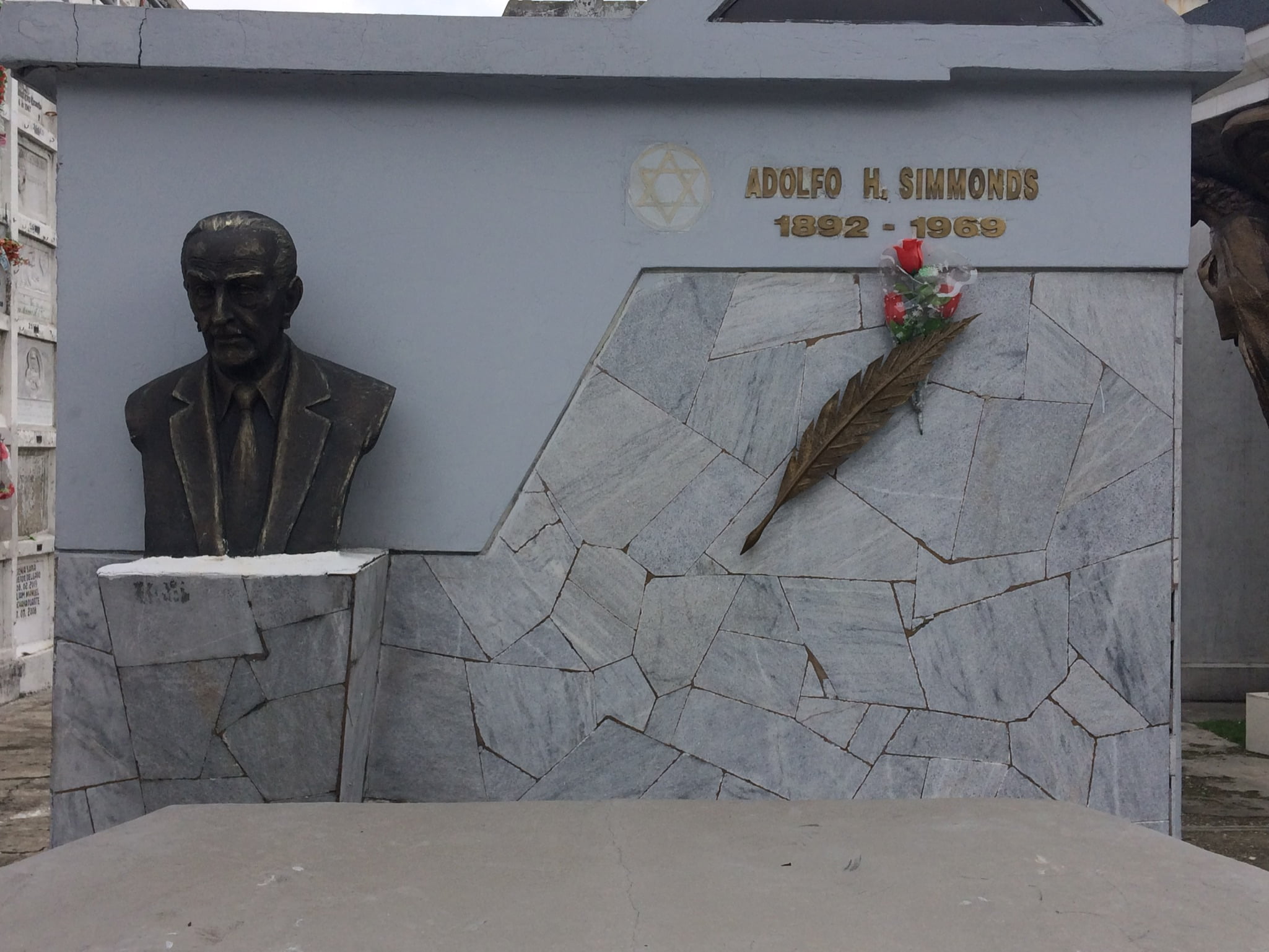
In the general part of the cemetery I stumbled upon the more elaborate tomb of a Jewish personality – that of Adolfo H. Simmonds, a Jewish Zionist journalist who lobbied for Ecuador to receive Jewish refugees from Europe and for the recognition of Israel, and thanks to whom Ecuador voted in favor of the UN Partition Plan for Palestine in 1947.
Behind locked gates on a hill next to the Municipal cemetery stands the so-called “Foreigners Cemetery”, which has been closed to the public since 2013. It was established in 1870 as the resting place of people from other countries (and non-Catholics) who by chance died in the city; around 190 people are buried here. This place is also known by the people of Guayaquil as the “Jewish cemetery,” even though there are only a few tombstones of Jewish foreigners buried here – the graves date back to the 1870s and are likely the graves of visiting merchants or businessmen.
Not far away from the city center stands the large and modern synagogue complex, inaugurated in 2012, that also hosts a mikve, a kindergarten, a Talmud torah and other social facilities.
CUENCA
Unlike Quito and Guayaquil, in the southern city of Cuenca there is no longer an established Jewish community. The history and heritage of the city’s Jewish past is today preserved by a few descendants and a young scholar from Cuenca University, Agatha Rodríguez Bustamante, a historian who has dedicated the past few years of her work to the history of the Jewish community in this beautiful colonial city.
Agatha Rodríguez Bustamante drove me to the city’s small Jewish cemetery, a hidden section of the city’s municipal cemetery. She walked me through the tombstones while describing the family history of those buried, as she had interviewed them or their family members. As of today, she has co-authored two booklets about the Jews in Cuenca, Cultura y exilio. La migración judía en Cuenca (Culture and exile. Jewish migration in Cuenca), and a booklet in memory of Egon Schwarz, one of the most important members of the Jewish community in Cuenca, as well as an intellectual and university professor.

The Jewish section is recognizable thanks to the Star of David decorating the iron door, and by a plaque which was recently installed by the cemetery’s administration. The Jewish cemetery features around 25 tombstones, dating from the 1930s to the 1990s; the grass is perfectly taken care of thanks to the contribution of the descendants still living in the city. However, with the exception of a couple of tombstones, most of them are broken or scarcely readable.
Except perhaps to descendants and to the small Jewish community currently living in the country, Ecuadorian Jewish history is a largely forgotten story.
Even though over the decades, many Jews made important contributions in the economic and cultural spheres, most Ecuadorians ignore their history and heritage, and how their contribution was vital for the country’s economic development. At school, young Ecuadorians learn about WWII, its uncountable battles, and about the Shoah, but Jewish immigration in the country during those years is not even mentioned.
Despite this, Jewish built heritage is present and easily accessible. In fact, one might stumble upon it without even trying.

Randomly walking in the city center, I found a plaque outside the Cathedral, given by the foreign colonies (among them, the Jewish community) of the city as a present to the municipality, in appreciation of their friendly welcome. And inside Quito’s Scala shopping mall I found a statue of Manuel Antonio Muñoz Borrero, the Ecuadorian consul in Sweden during WWII and the only Ecuadorian honored by Yad Vashem as a Righteous Among the Nations.