
One of the most prominent features in the Bagnowka Jewish cemetery in Bialystok, Poland is a massive black granite pillar commemorating the scores of victims of the bloody pogrom that took place in June 1906 and two massacres that took place in 1905. An article on the web site of the Museum of Jewish Heritage called the 1906 pogrom “a violent reprisal against the labor movement by Russian authorities in the midst of the Russian Revolution of 1905 to 1906.” At the time, the city was in the Russian Empire and Jews made up a large majority of the local population. Thanks to the US nonprofit Bialystok Cemetery Restoration Fund, the pillar has been restored, and an inauguration ceremony will take place on August 11.
In this long-read article on the 118th anniversary the pogrom, the cemetery’s historian Dr. Heidi M. Szpek takes us on a deep dive into the history of the monument, the fruit of nearly 20 years of research. She has discovered who planned and erected the pillar and — almost — resolves the mystery of just when it was installed. She also provides a timeline of its history.
Mystery Solved – Almost! Dating the Memorial Pillar: Bagnowka Jewish Cemetery, Białystok, Poland
Dr. Heidi M. Szpek
June 9, 2024
“Stand strong, O Pillar of sorrow … though states and people may move, never move from your place.”
These words, composed by the Yiddish and Hebrew poet and novelist Zalman Shneour (1886-1959), conclude the poem engraved on the base of the black Swedish granite pillar that stands near center in Białystok’s Bagnowka Jewish Cemetery. The pillar commemorates victims of the 1906 Pogrom and two 1905 massacres in this city. Despite Shneour’s admonition to preserve this pillar, it has been moved – twice! In 1981 it was a victim of theft and vandalism, and two failed attempts were made to repurpose the stone. Though returned in 1986, the pillar was missing an upper register and bore the marks of vandalism. On a more positive note, in 2023, its removal for full restoration was coordinated and facilitated by the US nonprofit Bialystok Cemetery Restoration Fund and executed by the skilled stone conservator Bartosz Markowski of Warsaw. On November 3, 2023, the pillar was reinstalled.[1] It now stands strong once again as a symbol of remembrance and resilience against anti-Semitism. (The cover picture above shows the restored pillar.)

The Mystery
There is a mystery that surrounds this pillar, yet to be fully resolved: when was this pillar first erected and by whom? For nearly 20 years, as a specialist in Hebrew and Semitic Languages, a translator and historian for Bagnowka Jewish Cemetery, and now also as Vice-Chair of the Białystok Cemetery Restoration Fund (BCRF), I have sought an answer.
Until recently, the response has been that the pillar was erected prior to 1918 because the date on the historic inscription on the pillar follows the Julian calendar, which changed in February of 1918. Or: the pillar must have been created by the Bialystoker Center in New York, which in 1922 also sponsored and erected the nearby ohel for Rabbi Chaim Hertz Halpern, who died in 1921.
Local conservators and scholars accepted these responses, rationalizing that such a monument would not have been erected at a time when Tsarist Russia governed Białystok because of its complicity in the pogrom and massacres. Erecting such a monument would have been a great embarrassment! But the first response is inadequate; the second, wrong. Indeed, a memorial for the Odessa 1905 Pogrom was erected on October 14, 1914, as reported by the Yiddish newspaper, Unzer Leben.
In recent years, after exhausting traditional sources of research to date this pillar, I began contacting scholars whose research expertise might be of assistance, inquiring: Could the pillar be dated by determining the date when Shneour’s poem was composed? Was there anything about the pillar’s stone, engravings, or foundation that could contribute to dating the pillar itself? My contact list became an international Who’s Who of contemporary scholarship and craftsmanship, with unfortunately as many non-responses as responses. The end results, however, were dead ends.
Finally, a momentous breakthrough came last fall, just weeks after the BCRF’s yearly restoration work at Bagnowka was completed. During that restoration, a unique triple tombstone for a mother and two children was discovered. All three had perished in a mysterious house explosion in October of 1921. This discovery was shared on social media. By chance, Yiddish translator, Beate Schützmann-Krebs in Germany chanced upon this post. She thought information about the house explosion might be found in local daily Yiddish newspapers. Her hunch was correct. The Yiddish newspaper Der Freund held an answer to the events of October 1921.[2]
On return to my Seattle-area home, joined by my husband, the BCRF volunteer photographer and historian Frank Idzikowski, I resumed the quest to date this pillar. After exhausting additional US and European archives, we, too, were exhausted. And then I remembered Beate’s assistance, and I emailed her in late October. The next two months brought a flurry of emails between us, with ongoing contributions by Frank and Dr. Susan Pasquariella in New York. Together we discovered precise information to assist in dating this pillar. In November, Frank and I also met with Reference and Outreach Archivist Ruby Landau Pincus of YIVO, who directed us to additional resources in Israel, especially the National Library of Israel. Once again, an international community was engaged in dating this pillar. This time, however, there was no dead end.
The vague 12-to-16-year previous window (1906-1922) for the pillar’s possible erection was narrowed, as we will see, to a 12-17-month window. Within this window are key dates and people related to all aspects of the pillar’s creation: raising funds, preparing a plan, getting permission, seeking a poet, locating and purchasing the granite, and its arrival. I have put this all together to create the timeline below.
The critical sources for this timeline are Abraham Shmuel Herszberg’s, Pinkus Białystok, and select Yiddish, American, and Canadian newspapers. The key players in the creation of the pillar were three Russian Governors General and the son and grandson of two prominent and powerful opponents in 19th Century Jewish Bialystok – Yehiel Ber Wolkowyski, the unofficial head of the Jewish community for nearly 50 years (1850-1903), of whom it was written, “nothing got done without his intervention,” and Chief Rabbi Shmuel Mohilewer (1824-1898), known for his caring and quiet demeanor and as one of the founders of Religious Zionism.
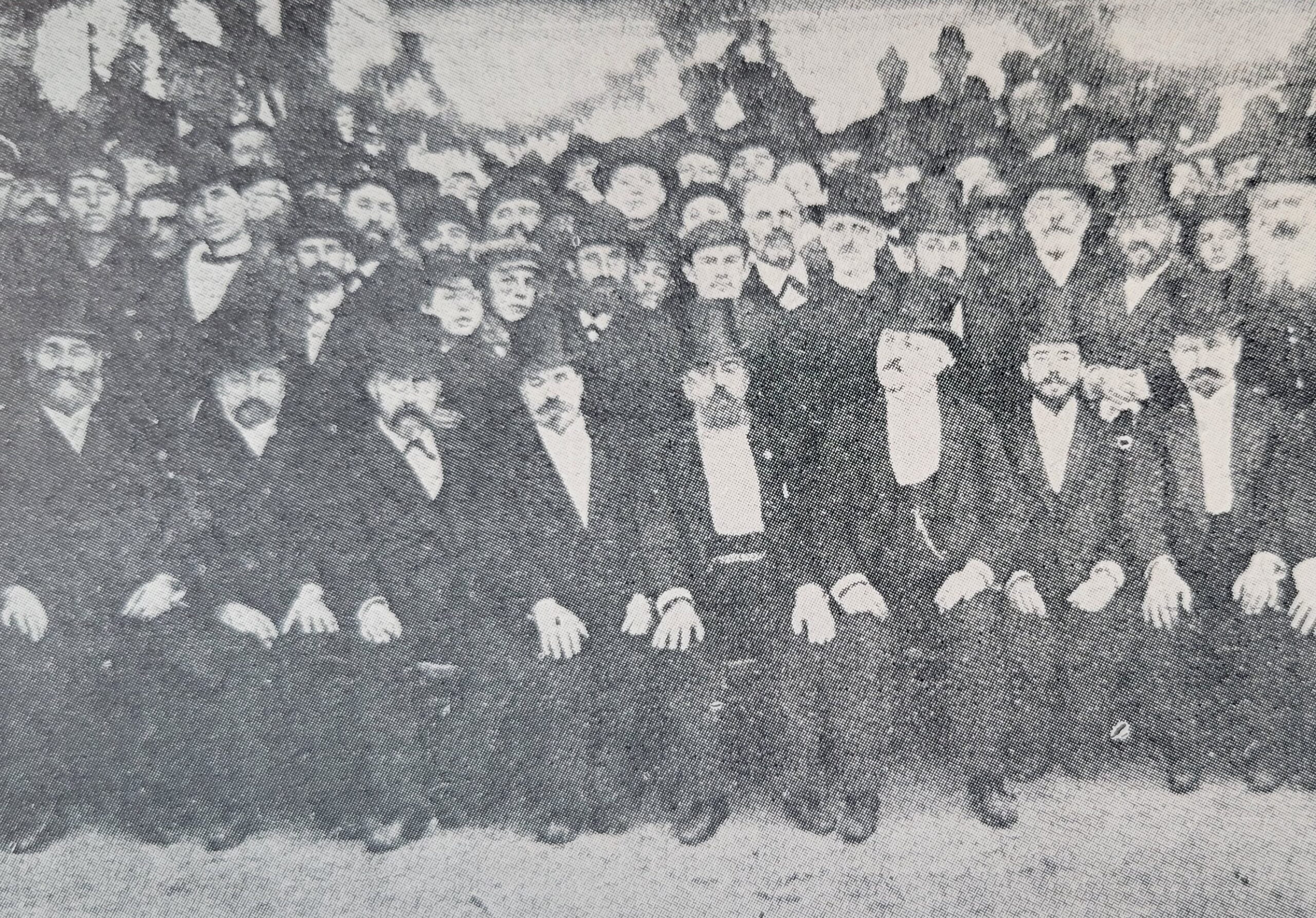
Wolkowyski was vehemently opposed to religious Zionism and to Shmuel Mohilewer. But it would be Wolkowyski’s only son, Avram Ber Wolkowyski, who chaired the Bialystok Committee, formed shortly after the 1906 Pogrom to coordinate funds for victims, and Mohilewer’s grandson, Dr. Rabbi Josef Mohilewer, who would be integral in coordinating nearly all aspects of the pillar. Their collaboration makes sense as both were on the Building Committee and Orphans Committee in 1906 as featured in photographs in the Białystok Photo Album.
The Annotated Timeline
June 1906, shortly after the pogrom, the Białystok Committee – in Białystok, was formed.
Under the chairmanship of Avram Ber Wolkowyski, this committee was tasked with appealing for donations internationally, as well as collecting, administering and distributing funds to those in need. A total of 307,600.00 rubles were collected from Jews and non-Jews in Russia, Poland and abroad. The committee’s expenses also included donations for the victims of the July 30, 1905, and the October 18, 1905, massacres, and … 6000 rubles donated for the pillar, as recorded by Avraham Shmuel Hershberg, Pinkus Białystok. These were tremendous donation amounts, given, for example, that the average salary of a coal miner in Russia was 40 rubles a month, a stonemason earned 32-35 rubles a month, or a factory worker 206 rubles per year.[3]
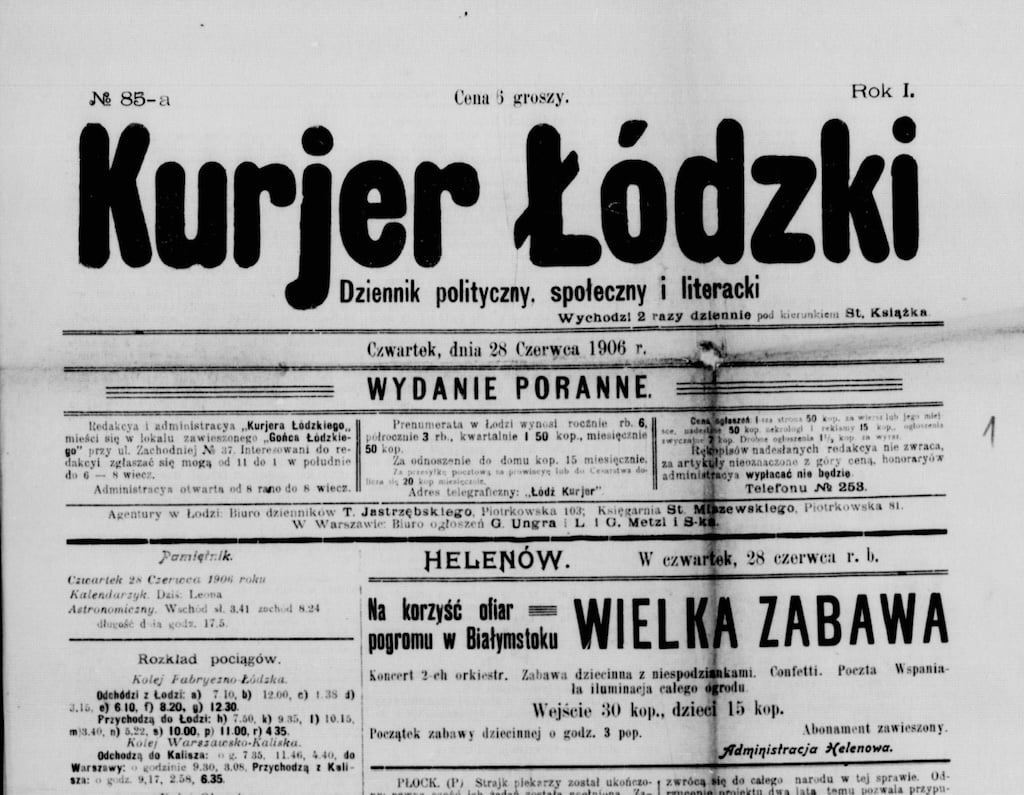
While Hershberg listed over forty newspapers, Jewish and non-Jewish, that raised these funds, Frank also found the Lodz Jewish newspapers an excellent resource. The Neue Lodzer Zeitung (June 15/28, 1906) and the Kurjer Lodzie (June 15/28, 1906) listed the names and number of rubles collected by committee members. The Kurjer Lodzie ran a short article about a hair salon that was donating funds from haircuts on a specific day to the pogrom aid fund. And an advertisement in The Lodz Kurier (June 28, 1906) invited the Lodz community to Wielka Zabawa (Great Fun) that would feature two concerts, a children’s play and more to raise funds!
September 15, 1908, the granite arrived, and a poet has been contacted.
The Yiddish daily, Der Freund (דער פֿרײַנד), the first Yiddish daily newspaper in Tsarist Russia, reported: “Finally, it is to be hoped that the project of erecting a common matzevah for the victims of the pogrom will soon be realized. The granite has recently arrived and the Rabbi, Dr. Mohilever, has just written a letter to our well-known poet, Ch. N. Bialik, to write a text for this matzevah. AND:
September 24, 1908, Mohilewer asks the Governor General for permission to erect a memorial.
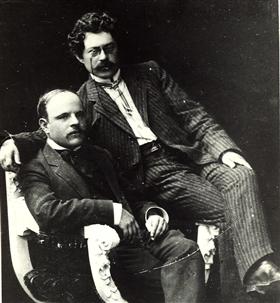
The Yiddish newspaper, Haynt, reported that the Chief Rabbi (Josef Mohilewer) of Bialystok asked the governor general to erect a memorial, literally, he asked “to place a matzevah on the grave of the Jewish victims of the 1906 pogrom.” Haynt also reported that “the great Jewish poet, Chaim Nahman Bialik was commissioned to write the inscription.” On October 16, 1908, Hebrew Standard (New York), America’s leading Jewish newspaper, also reported that “a monument will shortly be erected to the Bielostok pogrom victims. Rabbi Dr. Mohiliwer is already in possession of the granite, and the famous poet Byalik has been entrusted with the task of drawing up the text of the memorial inscription.”
Thus, before this reporting date (September 1908), the granite and a poet were in place.
Governor General was an administrative position (1775-1917) appointed by the Tsar. Bialystok belong to the Vilna governorate and from 1906-1913, after which it was dissolved, three generals held this position: General Konstantin Krzhvitsky (January 1, 1906 – March 1909), General Sergei Konstantinovich Gershelman (March 17, 1909 – November 17, 1910) and General Fydor Martson (November 23, 1910 -January 17, 1913). Rabbi Dr. Mohilewer’s request initially would have gone to the first of these Governors General, Krshvitsky.

The modern Hebrew poet extraordinaire, Chaim Nahman Bialik (1873-1934), was a mentor and father-figure to Zalman Shneour.
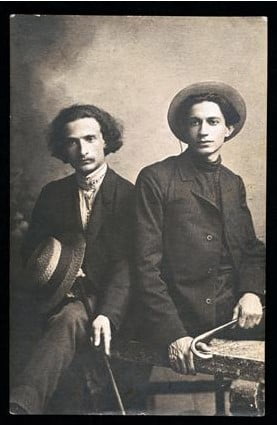
Shneour and other young poets of the day, known as the Pleiade group, were very much influenced by Bialik. Bialik’s poem, “In the City of Slaughter,” written in 1904, recalls the horrors of the 1903 Pogrom in Kishinev. The poem on the Memorial Pillar bears haunting echoes of Bialik’s composition. Indeed, the now restored missing upper register bears the words “Valley of Slaughter,” also an echo of Bialik’s own title, “In the City of Slaughter.” Still, while Hershberg declared Zalman Shneour as the author and documentation exists of Bialik’s rejection of Mohilewer’s invitation, debate continues over the poem’s authorship.
May 19, 1909, a plan for the monument is in place.
The Yiddish newspaper, Unzer Leben, reported that “the Bialystok community has a plan to erect a monument (denkmal) to the victims of the 1906 pogrom. If this permission is granted, the committee formed shortly after the pogrom will take care of its realization.” This article again acknowledges the committee formed shortly after the pogrom, the plan and that permission has been requested but not yet granted. Given the date, May 19, 1909, the next Governor General would be General Gershelman, who took up the position in March of 1909. Perhaps this change of office also explains the delay in approval.
June 11, 1909, a monument is to be erected.
Just under a month later, the Canadian Jewish Times lead its column, NEWS FROM EVERYWHERE, with: “A monument to the victims of the pogroms is to be erected in Bialystok.” Thus, a little over three years after the 1906 Pogrom, the pillar is yet to be erected.
Fast forward:
November 16, 1911: Der Moment (Warsaw) published an article about one B. Yushzohn’s visit to Bagnowka Cemetery.
The article records the mass grave, three rows of symbolic matzevoth, the pillar, the poem, and Bundist Ester Riskind’s memorial. Riskind was a victim of the 1905 Shabbath Nahamu Massacre. Her name, however, is not recorded on the pillar with other victims of this massacre. Writes Yushzohn:
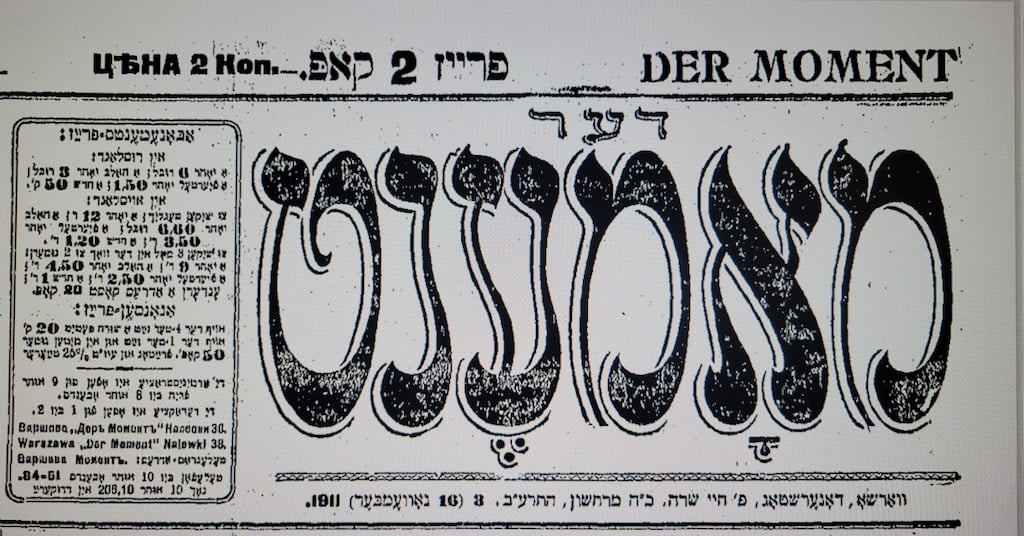
“Only in the afternoon, I visited some acquaintances and went with them to ‘Bagnovka’, to the cemetery where the bruder-keyver (mass grave) of the Bialystoker saints is located. … But what do they say, the silent, cold graves? And silent and cold as the graves themselves, I stand between the three rows of kedoshim, the holy people, and my eyes wander from one tombstone to the next … New expressions, new words… There is the gravestone of a Jewish girl, written in Yiddish and just a few simple words! ‘Fallen on October [sic] 18 … her friends!’[4] In front of the rows of graves in a specially designated area, stands the general bruder-matzevah, made of black marble and covered on all four sides with letters glittering in gold. On three sides, from top to bottom, there are the names of the murdered and holy people, and on the first side, facing the graves, is a lament written in sorrow and anger, and each of its words moves to tears with its sorrow and cuts to the heart with its protest …”
This article is critical for acknowledging all components of the Memorial Complex were in place on November 16, 1911. The window for the pillar’s actual erection is now June 11, 1909, to November 16, 1911. Within this window, however, there is compelling evidence to narrow this margin.
November 1910: Memorial to Bundist Ester Riskind is erected.
This monument, erected for the fifth anniversary of the Shabbath Nahamu massacre (July 30, 1905), stands directly in front of the western (main) side of the Memorial Pillar, the side that bears the poem.
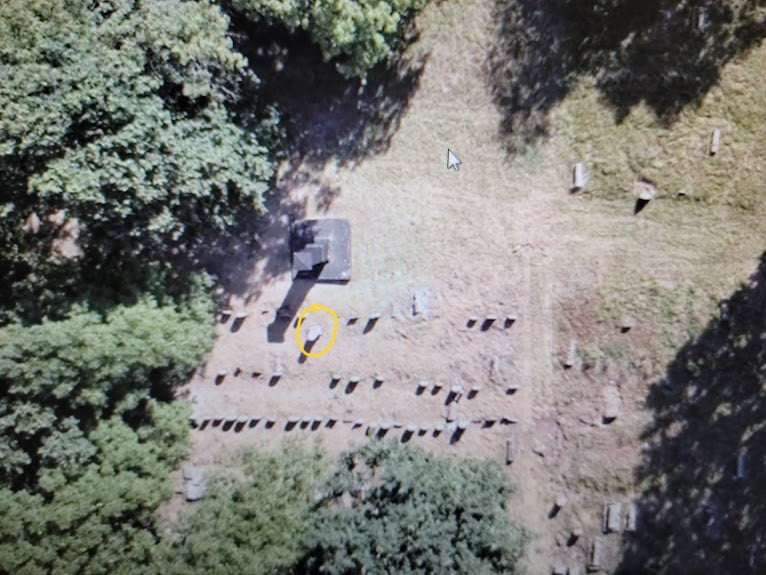
It is in a row with other symbolic matzevoth for women victims of the 1905 Massacres and then the 1906 Pogrom.
Behind this row stand two more rows of symbolic matzevoth for male victims of these massacres and for the 1906 Pogrom. There is an intentionality to the placement of these symbolic matzevoth, as there is to Ester Riskind’s anniversary memorial and the pillar itself.
The question is: Which came first? The symbolic matzevoth, the pillar or Ester Riskind’s memorial?
AND:
As noted, Governor General Sergei Konstantinovich Gershelman, the highly decorated “Iron General” assumed the position of Governor General of the Vilna Governorate on March 17, 1909.
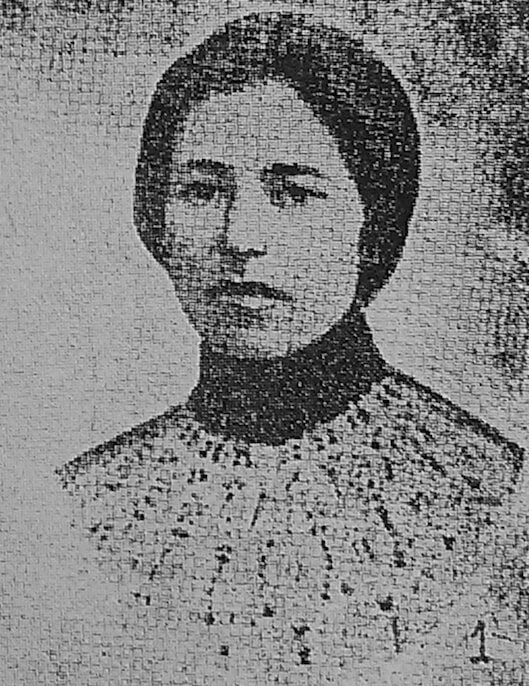
Before this post, Gershelman served as Governor General of Moscow. He was an ardent opposer to “revolutionary manifestations”, including the radical Black Hundreds, a leftist group within the Bund. Gershelman, dubbed the ‘hangman’ by these radicals, repeatedly eluded their attempts to assassinate him. Gershelman, however, was transferred to the Vilna Governorate to protect the Russian borderland. History records that he had not yet proved himself in this new position and due to declining health, he died on November 17, 1910.
Riskind’s memorial was erected by her Bundist friends at Bagnowka sometime in November 1910. Perhaps given the ineffectualness of the governate at this time in history, the pillar was also erected.
Let me speculate
- Shortly after the June 1906 pogrom, a mass grave, more properly a trench grave, was prepared for the victims. In September 2023, the area beneath which the pillar stands was examined using ground penetrating radar. No mass grave was found. However, the three rows immediately adjoining the pillar, especially the third row, suggest a trench-style grave was prepared. Row 3 contains 27 symbolic matzevoth marking male victims of the 1906 Pogrom. Throughout Bagnowka, typically 15-19 burials are recorded for each row. The overcrowded nature of this row and adjoining row suggests a trench grave.
- The delay in arranging permission for the pillar may have prompted individuals or the community to erect individual symbolic matzevoth, arranged by gender and event over the trench-style mass grave. We cannot be sure that these stones mark precise gravesites. Elsewhere in the cemetery are also individual gravesites with matzevoth that remember select victims. Indeed, one victim (Yitzhak Slon) is remembered on the pillar, on a symbolic matzevah and at an individual gravesite with a matzevah.
- In November 1910, Ester Riskind’s memorial was erected by her Bundist friends. Her memorial is placed precisely among other women victims of the 1905 Shabbath Nahamu massacre, suggesting the symbolic matzevoth were already in place.
Was the pillar in place when Riskind’s memorial was set?
An article in Der Moment just over a year later, on November 17, 1911, indicates the pillar was in place. I suggest it was in place before Ester Riskind’s memorial was erected.
Riskind’s true name is used on this memorial. Her nom-de-guerre, Hinda Beyla, is found on the pillar and on a symbolic matzevah; both preserve a vacat where her father’s name should typically have been recorded.
I suggest that Riskind’s memorial was specifically erected because her true identity would have otherwise been lost. Moreover, November 1910 offered the perfect opportunity to erect Riskind’s memorial and the months before that, perhaps even in June 1910, the fourth anniversary of the June 1906 Pogrom, would have been an advantageous time to erect the pillar, given the tenuous nature of the Governorate General. By November 23, 1910, General Fydor Martson would take up this post. If this permission was the cause of the delay in erecting the pillar, the process of receiving permission would have begun anew with Martson.
Hereafter, articles in Jewish newspapers worldwide focus on anniversaries of the 1906 Pogrom and 1905 Massacres. These include an article in the Jewish Daily Bulletin (August 17, 1930) reporting the 25th Anniversary of the Shabbath Nahamu, which was commemorated by procession through the same streets and then to the cemetery with laying of wreaths. And an article in The Australia News (June 24, 1966) reporting on the 60th Anniversary of the 1906 Pogrom, mentioning the mass grave and pillar, still in place but wuth fading inscriptions. The Forverts (December 20, 1957) reported a visit to Białystok by one Sh. L. Schneiderman, who wrote: “there stands undamaged the huge monument to the memory of the saints, who died during the Białystok pogrom of 1906. On the tall marble, there is a ‘shir’ engraved by Chaim Nachman Bialik and the names of the 200 saints, who fell during the terrible Tsarist pogrom.” Note, even in 1957, authorship of the poem was questioned. And again, in an article from Der Tog, Morgen Zhurnal, a daily Yiddish newspaper, dated February 12, 1965, one reads: “The Rabbi of Białystok, Dr. Yosef Mohilever, had approached Bialik with the request to write an epitaph for the Bialystoker memorial column as well: ‘I am turning to you on behalf of the committee (to preserve the memory of the Białystok victims) so that you would be so good as to write a number of warm sentences […] about the murdered people. There may be up to 1100-1200 letters. […].’ However, his wording offended Bialik and he refused.”
Questions remain surrounding the pillar:
Did Shneour compose this poem? Where precisely is the mass grave to the 1906 Pogrom? Where were victims of the 1905 Shabbath Nahamu massacre buried? Who carved the pillar? Were Governors General truly engaged in gaining permission for the pillar?
Foremost, however, at present is: Do we have the exact date when the pillar was erected? No. But the near exact date? Yes! For now, I can say, with conviction, that by November 17, 1911, the pillar was erected.
I suggest, however, it was before Ester Riskind’s memorial was erected in November 1910. Moreover, we now have names and faces and the correct community involved in the pillar’s erection – the Białystok community in Białystok! These individuals persevered against ongoing Tsarist suppression of Jewish rights, demanded to preserve memory and succeeded at a time of great adversity. That is inspiring!
I am hopeful that a precise date for the pillar’s erection will still be discovered, and this mystery will finally be resolved. Digitalization of archival materials has exponentially increased, making records widely available. Ancestral records and photos continue to be discovered. Meanwhile on August 11, 2024, the Białystok Cemetery Restoration Fund will hold a rededication of the newly restored Memorial Pillar. All are invited!
– – – – –
Dr. Heidi M. Szpek is Emerita Professor of Religious Studies at Central Washington University and translator and historian of the Bagnowka Jewish cemetery; she is also a member of the board of the Białystok Cemetery Restoration Project. She edits the web site www.jewishepitaphs.org and is the author of the book Bagnówka: A Modern Jewish Cemetery on the Russian Pale.

– – – – –
Select Sources:
Avraham Shmuel Hershberg, Pinkus Bialystok, New York (1950): Volume I: 249-268).), (Hershberg, II: 127-131, 346-347), (Yiddish) https://www.jewishgen.org/yizkor/bialystok/bialystok.html
The Illinois University Library. Digitized Historic Polish Newspapers, https://guides.library.illinois.edu/digitizedpolish
Andrey Ivanov, “Honestly and menacingly in the spirit of primordial Russian principles”: Moscow Governor-General S.K. Gershelman, November 22, 2008. (Russian)
National Library of Israel https://www.nli.org.il/en
David Sohn, editor, Bialystok Photo Album. New York, 1951.
Heidi M. Szpek, Bagnowka: A Modern Jewish Cemetery on the Russian Pale. IUniverse, 2017, especially Ch. 5 The Memorial Complex.
Vilna Military District. https://military-history.fandom.com
YIVO-Institute of Jewish Research https://www.yivo.org/
Footnotes
[1] On the pillar’s journey to restoration, please visit: https://bialystokcemeteryrestoration.org/memorial-pillar-restoration/
[2] For this story, please visit: https://bialystokcemeteryrestoration.org/and-the-pieces-come-together-the-2023-final-report-of-the-bialystok-cemetery-restoration-fund/
[3] “Wages and Buying Power, 1895-1905.” www.kehilalinks.jewishgen.org
[4] Yushzohn has erroneously translated Riskind’s epitaph, which reads: “Here lies – Ester Riskind has fallen on the 30th of July (Shabbath Nahamu) 1905. Her friends / November 1910.” He seems to have misread or confused her death in the Shabbath Nahamu Massacre in 1905 with the October 18, 1905 storming of the city jail, prompted by the events of the October Manifesto.