
There are around 1,200 or more Jewish cemeteries around Poland, most of which have no gravestones (or only a few). Scores of synagogue buildings also still stand, though only a tiny handful are used still as Jewish houses of worship. You can access information on most site via the general links below, in particular Virtual Shtetl. In addition, we provide further links to a number of sites that have their own web resources or other material.
Search our news items for Poland to find further updated information
GENERAL (NATIONAL)
A one-stop shop for information on thousands of Jewish heritage sites around Poland and parts of Ukraine, Belarus and Lithuania. A vast and expanding online database and also a frequently updated news source on Jewish heritage, history and culture in towns and cities all over Poland. A project of the POLIN Museum of the History of Polish Jews, it offers most of its material in Polish, English, German, and Hebrew.
FODZ — Foundation for the Preservation of Jewish Heritage in Poland
Established by the Union of Jewish Communities in Poland and the World Jewish Restitution Organization (WJRO) to protect and commemorate the surviving monuments of Jewish cultural heritage in Poland. The Foundation is active in regions where there are no nearby active Jewish communities, an area covering nearly two thirds of Poland. Among its project is the Chassidic Route — a loosely linked network of more than 20 Jewish heritage sites in southeastern Poland, for which FODZ has prepared information including downloadable brochures (from the Downloads Panel in the sidebar).
Interviews by Leora Tec with non-Jewish Poles who care for Jewish cultural heritage
A web site in French about traces of Jewish heritage in Poland, featuring photographs and information on hundreds of Jewish cemeteries, synagogues and other sites.
U.S. Commission Survey of Jewish Heritage Sites in Poland
Downloadable PDF file of the first fullscale post-Holocaust survey of Jewish heritage sites in Poland — mainly synagogues and Jewish cemeteries, carried out in the 1990s.
National Heritage Board of Poland
An interactive map of all landmarked heritage sites and monuments in Poland.
JEWISH CEMETERIES
Coalition of the Guardians of Jewish Cemeteries
Network of individuals, NGOs, institutions and others who clean-up and maintain Jewish cemeteries in Poland, coordinated by the National Heritage Foundation in partnership with FODZ, Jewish community organisations and others.
Database including transcriptions of inscriptions and photographs of gravestones in dozens of Jewish cemeteries around the country. Founded by the Warsaw Jewish Community and constantly expanding, it partners with the Jewish Records Indexing Poland (JRI-Poland).
Cemetery documentation project by students and faculty of the Re’ut school in Jerusalem, with databases on 15 Jewish cemeteries in Poland
Legislation Regarding Cemeteries, including Jewish Cemeteries, in Poland
A report by the Lo-Tishkach NGO, first published in 2007 and updated in 2017
International Jewish Cemetery Project Page for Poland
Listings for Jewish cemeteries all over the country, with location data and other information.
Comprehensive web site on Jewish cemeteries in Poland, with lots of pictures — fruit of many years of research by Krzysztof Bielawski. The go-to web site for Jewish cemetery information (the text is in Polish).
Museum of Family History: Holocaust Memorials in Poland (The Cemetery Project)
The Matzevah Foundation: Remembering, Restoring, Reconciling
A Baptist Christian foundation that sponsors restoration and clean up work in Jewish cemeteries in Poland.
Obecnie Nieobecni (Currently Absent)
Web site of a nationwide photographic historical project concentrated on a symbolic value of presently non-existent Jewish cemeteries. It shows places that once were (visible) Jewish cemeteries.
GENERAL (REGIONAL)
EAST AND NORTHEAST POLAND
Database, photographs, videos and other material on Jewish cemeteries and other Jewish heritage sites in scores of towns, cities and villages, primarily in eastern Poland. The site was founded by researcher Tomasz Wisniewski.
Białystok Polish-Israel Education Center
Information on history and Jewish heritage sites in eastern and northeastern Poland. There are lists and pictures of synagogue buildings and Jewish cemeteries and mass graves in dozens of towns and cities — click the links in the sidebar.
Web site about Jewish history, life & heritage in East Prussia (now divided among Lithuania, Russia & Poland)
GALICIA (SOUTHEAST POLAND/WESTERN UKRAINE) AND EASTERN POLAND
A loosely linked network of more than 20 Jewish heritage sites in southeastern Poland, for which FODZ has prepared information including downloadable brochures (from the Downloads Panel in the sidebar).
Extensive photographic documentation by Charles Burns of Jewish heritage sites, mainly in parts of Poland, Romania and western Ukraine, with a focus on Jewish cemeteries, including many images of individual gravestones. Dozens of towns are included.
A genealogy web site with many resources — including a “map room” with historic and cadastal maps of a number of towns and cities.
Web site with extensive resources on Jewish heritage (and built heritage).
Extensive information about Jewish heritage in dozens of mainly small towns in the Poland-Belarus-Ukraine border regions. A large Jewish heritage tourism and research project carried out thanks to an EU grant.
SILESIA
Bits of the History of Jewish in Silesia
Downloadable PDF book (published in 2014) that includes the history, and historic images, maps, etc, regarding synagogues, Jewish cemeteries, and other Jewish sites in several towns and cities: Jelenia Góra; Kamienna Góra; Jawor; Strzegom; Kowary; Kłodzko; Legnica; Świdnica
WARSAW
Much of Warsaw was destroyed in World War II, including almost all sites of Jewish heritage. Today, main heritage sites include the Nożyk synagogue (the only intact synagogue still standing in Warsaw); one block of Prózna street; the Jewish cemeteries on Okopowa street and in the Praga district (Brodno cemetery); remains of a private prayer house in Praga; the Jewish Historical Institute, located in the former building of the Jewish Library. There is a memorial trail in the destroyed WW2 Warsaw Ghetto area and several monuments to the Holocaust, including the Ghetto Heroes Monument, across from the new POLIN Museum of the History of Polish Jews, which opened in 2014.
Information for the Jewish Tourist in Warsaw (Fact Sheet and Tourist Guide)
An information resource prepared by the Jewish community in Warsaw with tourist and logistical information, and information and contacts regarding synagogues and other Jewish institutions, Jewish heritage, sights, kosher food, etc.
ul. Twarda 6
Tel: +48 502 400 849
The only synagogue to have survived World War II in Warsaw intact, it was founded as a private synagogue by businessman Zalman Nożyk and his wife Rivka. It opened on 12 May 1902. Desecrated during WW2, it was used after the war by the survivor community but closed down in 1968. It stool empty until renovation allowed it to reopen in 1983 and today serves the city’s orthodox Jewish community.
Article about the synagogue by Haim Ghiuzeli on the Bet Hatftusot web site
Jewish Cemeteries
Jewish Cemetery at Okopowa St.
Vast cemetery founded in 1806 and occupying more than 33 hectares (82 acres). There are scores of thousands of grave markers, ranging from opulent mausolea to simple matzevot, and as many as 250,000 burials, including mass graves. Much of it is overgrown. The Polish government announced in 2017 it was investing €24 million toward its restoration and clean-up. This extensive web site provides historical and other information, including progress reports on the restoration.
Okopowa St. Jewish Cemetery searchable database
Names, dates, description, location and photograph of each gravestone
Okopowa St. cemetery on Virtual Shtetl
Bródno Jewish Cemetery — Permanent Exhibition Beit Almin Eternal Home
15 św. Wincentego Street, 03-505 Warsaw
Tel: (+48) 22 678 74 53, (+48) 504 906 258
Email: [email protected]
Founded in 1780 and used until 1940, Bródno, in the Praga district, is the oldest surviving Jewish cemetery in Warsaw and the largest in terms of the number of burials — more than 250,000 are believed to be interred there. It occupies more than 12 hectares. Most of the headstones were uprooted for use as construction material and thousands remain piled up on the site. A visitor center and permanent exhibition opened in early 2018. The exhibition focuses on both the history of the cemetery and on Jewish death and mourning customs, using text, photos, maps, and other images. Click to see our article and photos.
Virtual Shtetl page on the Bródno cemetery
A collection of facts from the history of the ghetto based on archival and bibliographical data. The Internet database enables its users to easily find related information on specific subjects: people, events and places from the Warsaw ghetto.
Photographs, maps and resources on Warsaw before World War II, showing the architectural and social fabric of the city that was largely destroyed in the war.
Virtual tour of pre-World War II Jewish Warsaw
Google virtual tour of an exhibit at the POLIN museum
KRAKOW

Krakow’s old Jewish quarter, Kazimierz, is the largest, most intact, and best-preserved Jewish quarter in Europe. There are seven synagogue buildings, various prayer houses, two Jewish cemeteries, homes, streets, market squares (including today’s Plac Nowy) and other infrastructure, as well as two Jewish museums, an active religious community and a lively JCC. .
Since the early 1990s, the area has developed (and been developed) into one of Europe’s main Jewish tourist attractions.
Virtual Shtetl’s pages on Krakow
Exhaustive information about the Jewish heritage sites around the city.
Jewish Krakow: A Visual and Virtual Tour
The web site lists places to see and locates them on a map; it also lists accommodation, restaurants and cafes in and around the Jewish quarter, Kazimierz. Lots of information.
See a PDF list of all synagogues and prayer houses (betei midrash) in Krakow in 1918-1939
Here are some of the main Jewish heritage sites in Krakow. Check the links above for detail information.
Synagogues
Szeroka 24, 31-053 Kraków
Tel: +48 (0) 12 422 09 62, 12 431 05 45
Fax: +48 (0) 12 431 05 45
Email: [email protected]
A gothic building that originally probably dates to the 15th century and was the first synagogue to be constructed in Kazimierz. It was reconstructed by the Italian architect Mateo Gucci in 1570, who gave it a Renaissance form, and it has undergone further remodeling and renovation over the centuries. It dominates one end of Szeroka, the main square of Jewish Kazimierz. Desecrated during the Holocaust, it was restored in the 1950s and reopened in 1959 as the Jewish History branch of the Krakow City Museum.
Remuh Synagogue
Szeroka 40
Set back in a courtyard and built in the 1550s at the edge of a newly established Jewish cemetery (today known as the Old Cemetery), it is the main active synagogue in the city today. The synagogue was founded by Israel Isserles, the father of the important sage Rabbi Moses Isserles, or Remuh, whose tomb in the Old Jewish Cemetery next to the synagogue is still a place of pilgrimage.
See article about the Remuh Synagogue on the Bet Hatfutsot web site
Tempel Synagogue
Originally built in 1862, this reform synagogue was restored in the 1990s and still serves as a house of worship, as well as a setting for concerts and other events. It was restored in the 1990s, one of the first major synagogue restoration projects to be undertaken in post-Communist Europe.
Brochure about the Tempel Synagogue restoration
Kupa Synagogue
Dating from the 1640s and remodeled over the centuries. It was devastated by the Nazis and used for decades after World War II as a workshop. Fullscale renovation was completed in 2002. The synagogue is richly decorated with ceiling and wall paintings dating from the 1920s-30s, showing of biblical scenes and signs of the Zodiac, as well as other decorative elements. It is used for services as well a cultural events.
Read Samuel Gruber’s article on the decoration of the Kupa
Izaak Synagogue
Kupa 18
Built in the 1640s. The synagogue was restored in the 1990s, revealing beautiful, if fragmentary, frescoes and richly decorative stucco work and other architectural detail under a lofty vaulted ceiling. It is used for religious services today as well as cultural events.
High Synagogue
Jozefa 38
The synagogue, on a upper floor was built in around 1560 near what was then a gate into the Jewish town. The façade features four buttresses and three arched windows. Today it serves as a culture venue; on the ground floor is the Austeria Jewish book store. Two doors away, a Hebrew inscription and two stars of David can still be seen on the façade of a former prayer house.
The Popper Synagogue (also called the Bocian Synagogue) built around 1620, stands in a courtyard off Szeroka 16. Its heavily buttressed structure remains intact, but all interior decoration has been lost, and the synagogue has long been used as a cultural center.
Jewish Cemeteries
Two Jewish cemeteries survive in Krakow. the Old Jewish Cemetery, next to the Remuh Synagogue and entered from the same courtyard, was founded in the mid-16th century and used until 1800. The resting place of Moses Isserles Remuh and other figures, It is a place of pilgrimage The Old Cemetery was already in poor condition in the 1930s and was devastated by the Nazis. In 1959, however, excavations unearthed hundreds of ancient tombstones and fragments that had been buried under the surface. More than 700 tombstones were re-erected in neat rows, providing what is more of a museum of cemetery art than a real cemetery. Broken fragments of tombstones, meanwhile, were used to create a mosaic memorial wall.
The New Jewish Cemetery, at Miodowa 55, was founded in 1800, after the Old Cemetery went out of use. It is a vast expanse that encompasses thousands of tombstones, many of which are beautifully carved, and is still in use by the Jewish community.
An article we published on our web site by Dr. Monika Murzyn-Kupisz, which she presented in the session “JEWS AND JEWISH DISTRICTS IN EUROPEAN CITIES, 18TH TO 21ST CENTURIES” at the “XI International Conference on Urban History – Cities & Societies in a Comparative Perspective” organized by the European Association for Urban History at the Charles University in Prague, 29.08-01.09.2012
ELSEWHERE IN POLAND — INDIVIDUAL SITES
There are hundreds, perhaps thousands, of Jewish heritage sites in Poland. You can find lists and information on most of them from the links cited above — in particular from the Virtual Shtetl portal, which provides material on about 2,500 places. Some of the links above lead to searchable databases with extensive and often quite detailed information. Here below we include a selection of locations that have their own web sites and/or other elaboration online.
BĘDZIN
Remains of Jewish quarter with some small, private prayer houses. Jewish cemetery.
Synagogues
A private prayer house found hidden in an upstairs apartment at Aleja Kollataja 24 — in a building that was part of a grand complex of tenement dwellings and businesses owned by Nuchim Cukerman. It was renovated and reopened to the public thanks to a grant from the province. The striking wall paintings that show scenes of Jerusalem, musical instruments and other motifs, were preserved and restored during a six-month restoration project overseen by the Brama Cukermana (Cukerman’s Gate) Foundation, a local NGO dedicated to preserving Bedzin’s Jewish heritage.
Mizrachi Synagogue
The so-called Mizrachi synagogue, believed to date from the mid-1920s, is located in a building at ul. Potocki 3 in the former Jewish quarter. It was used by the members of the Mizrachi religious Zionist organization.The founder was probably the owner of the entire building, a man named Wiener, who was active in the movement. Restoration carried out by local authorities was completed in November 2011.
Jewish Cemeteries
Two Jewish cemeteries have been destroyed. Two remain.
Podzamcze Street, below the castle
Founded before 1830; several hundred gravestones survive in the steep hillside cemetery, the oldest legible from 1831. Some restoration is ongoing. See article on kirkuty web site.
ul. Czeladzka 64, on the border of Bedzin and nearby Czeladz
Founded in 1916, heavily damaged during and after WW2 but restored in 1988 and after. The cemetery has about 3200 gravestones, all of which have been photographed and are included in the JRI-Poland database. See article on kirkuty web site.
Brama Cukermana (Cukerman’s Gate) Foundation
BIAŁYSTOK
Three surviving (though transformed) synagogues; one surviving Jewish cemetery (out of six pre-war cemeteries). Numerous former Jewish buildings; various memorials (including to the destroyed Great Synagogue).
Jewish Heritage Trail in Białystok
A project of the University of Białystok Foundation, the web site has information (in English and Polish) on Jewish heritage sites — most of them only marked with a plaque — in the city. There is also a downloadable PDF guidebook brochure, published in 2008 and a Jewish Heritage Trail smartphone app (available for Android)
Wschodnia street
Founded in about 1890, this is only only surviving Jewish cemetery in Białystok, out of six pre-war Jewish cemeteries. Located next to a Catholic cemetery and in Orthodox cemetery, it once once extended over nearly 45 acres and was divided into 100 sections, with nearly 45,000 graves. Today, it covers about 30 acres and includes only about 2,100 matzevot.
All of the stones have been photographed, and the epitaphs have been translated. This information can be found online, but in the cemetery itself, signage has been erected next to some of the stones containing translations of the epitaphs and other information.
Online virtual tour of the cemetery
Downloadable Guidebook to the Cemetery
A 34-page guidebook to the cemetery by the scholar Heidi M. Szpek, who translated all the epitaphs.
“In the Bloodshed of Their Days”
Online article in Jewish Magazine about the cemetery, focusing on epitaphs, by the scholar Heidi M. Szpek, who translated all the epitaphs (it is her translations that are found on the cemetery signage and the Bagnówka web site). Szpek has also authored a downloadable guide to the cemetery (see link above) and a book about it.
Tomasz Wisniewski’s comprehensive web site about Jewish heritage and history in Bialystok and surrounding region. Photos, films, databases, etc
BOBOWA

Synagogue from 18th century, noted for exterior wooden gallery and elaborate painted stucco frame for the ark. Long used as a weavers’ workshop it was returned to Jewish ownership in 1993, restored and redicated in 2003. It is now used for religious purposes and pilgrimage visits by followers of the Bobower rebbes. Jewish cemetery, high on a hill, where Bobower rebbes are buried.
BYCHAWA
Disused synagogue, purchased by a private individual who wants to restore it and set up a private foundation. There is a ruined Jewish cemetery across the street.
Web site about Jewish heritage in Bychawa
Synagogue
Kościuszki, 23-100 Bychawa
Built around 1811 and damaged decades later in a fire; rebuilt in 1899. It has a massive four-pillar central Bimah and there are surviving polychome paintings on its walls, some of them portraying mytical animals; believed to be from early 20th century.
See Center for Jewish Art documentation of the synagogue
CHĘCINY
Synagogue built around 1640. During World War II the Nazis established a ghetto in Chęciny for some 4,000 people. They were herded into the synagogue in 1942 and deported to the Treblinka death camp. Devastated by the Germans, the synagogue was long used as a library and cinema in the post-war period, and also as a culture center and offices.
Owned by the city since 2019, it was reopened at the end of February 2024 after full renovation as a Center for Jewish Remembrance and Culture. It has an education center and a p[ermanent exhibition on local Jewish history.
There is a Jewish cemetery.
Web site of the Synagogue Center for Jewish Remembrance and Culture
This small town north of Krakow was 70-80 percent Jewish before World War II. Recent efforts spearheaded by local activist Piotr Krawczyk and town officials have renovated the long-abandoned synagogue into a state of the art Jewish museum and education center that features a unique glass bimah, and established memorials in the Jewish cemeteries. There is a well-preserved mikveh in the cellar of the former bath house, near the synagogue.
The Świętokrzyski Shtetl web site on the museum and Jewish history and heritage of Chmielnik also offers information on dozens of other towns in the Świętokrzysie voivodeship.
DIAŁOSZYCE
Synagogue originally built in 1845. Long ruined, it has been preserved as a ruin.
Formerly the German town of Reichenbach.
Synagogue
Ignacego Krasickiego 28, 58-200 Dzierżoniów
Built in 1875, the box-shaped neo-Romanesque synagogue was used by the local Jewish community until the Germans 1937 closed it down and sold it in 1937. After World War II and until the 1980s, the synagogue again was used for religious purposes by a renewed Jewish community of thousands of Holocaust survivors. Many had been liberated from the concentration camps, had survived the Holocaust in the Soviet Union, or had fought as partisans in Polish forests. Most of these people emigrated, and by the 1980s only a handful of Jews lived in the town; the synagogue was abandoned and became derelict.
It has been undergoing gradual restoration since 2004 by the Beitenu Chaj-2004 foundation. It is currently used for cultural purposes, but was opened for Rosh Hashana Services in 2009.
Downloadable PDF brochure on the synagogue and project
Synagogue dating from the second half of the 19th century and Jewish cemetery, both of which underwent renovation in 2015.
The Synagogue was used as a warehouse after 1945 and then after its roof collapsed, became a total ruin. In 1985-1991, it was renovated and a library was located there. As part of the €200,000 renovation completed in 2015 and carried out under the supervision of a historic preservation officer, windows and doors were replaced, plaster was filled in, the inside walls were renovated, and PVC tiles were replaced by terracotta. The building was drained and secured against damp. A small exhibition of photographs and Judaica was installed in the niche of the Ark.
The Jewish cemetery was established around the middle of the 18th century, and its eastern section was expanded in 1848. Severely damaged in WW2, it has about 400 surviving gravestones, the oldest from 1762. In 2015 underwent clean-up work and installation of new fencing and gates organized by the Foundation for the Preservation of Jewish Heritage in Poland (FODZ) and realized in cooperation with the ESJF (European Jewish Cemetery Initiative).
Shtetl Routes/Grodzka Gate Theatre Web Page on Jozefow
KARCZEW
A ruined 19th century Jewish cemetery on Otwocka street, built on a sandy dune near the Vistula River south of Warsaw. The oldest legible headstone is from 1876. It was devastated in World War II and after the war suffered further damage through vandalism, theft, and erosion. It was fenced in 2002.
See a video:
KATOWICE
Regional and industrial center with an active Jewish community and several remaining heritage sites.
Video with old postcard views and 3-D computer reconstruction of the Great Synagogue, destroyed on Kristallnacht:
Jewish cemetery, founded in 1868, at ul. Kozielska 16.
Virtual Shtetl page on Katowice Jewish cemetery.
The video below shows a “walking tour” of the cemetery
A beautiful town on the Vistula River, a resort town and artists’ retreat as well as a noted Jewish community. The synagogue, remains of Jewish cemetery with major Holocaust memorial; Jewish tourism infrastructure. There is a plaque memorializing the 3,000 or so local Jews killed in the Holocaust.
Synagogue
ul. Lublin 4
24-120 Kazimierz Dolny
Tel: +48 (0) 81 881 08 94 Mobile: +48 692 578 677
Email: [email protected]
Built in the second half of the 18th century, the synagogue was long used as a cinema after World War II but was returned to Jewish communal ownership in 2002. Today it is used as a cultural and exhibition space, housing a exhibition on Jewish Kazimierz Dolny that includes pre-war photographs by Benedykt Jerzy Dorysa. The synagogue complex also includes a guest house, called Beiteinu, run by the Jewish community in Warsaw, the “Esterka” kosher cafe, and a Judaica shop. The synagogue web site has information about the history of the building and the Jewish community of the town.
Jewish Cemeteries

Both of the town’s Jewish cemeteries (Old Cemetery on Lubelska, dating to 17th century, and New Cemetery or Czerniawy, established in 1851) were destroyed by the Nazis.
In the 1980s, a striking Holocaust Memorial in the form of a wall of hundreds of recovered gravestone fragments and split by a jagged crack was erected amid the remnants of the New Cemetery.
The Kazimierz Dolny Goldsmith Museum, a branch of the town’s Vistula region Nadwislanskie Museum, includes items of Judaica. Other branches of the town museum also present material on local Jewish heritage, including photographs and fragments of gravestones.
KIELCE
Former synagogue (now state archive); Jewish cemetery; private prayer house (ul Slowacki 4) built in 1922; site of July 4, 1946 pogrom against Holocaust survivors that killed at least 42 Jews (ul Planty 7).
25-502, 40 Paderewskiego
Tel: +48 (0) 41 343 28 40
Fax: +48 (0) 41 343 28 49
Email to Bogdan Białek, Chairman: [email protected]
An NGO that, in addition to carrying out civil society activities, manages the Jewish cemetery in Kielce and is working to preserve a rare, surviving private prayer house and move it to the Jewish cemetery where it will anchor an educational/cultural/memorial center.
KNYSZYN
The old Jewish cemetery with hundreds of gravestones, built on the dams of royal ponds, was founded in the 18th century; the oldest identifiable stone is from 1806. (There is a much smaller “new” Jewish cemetery founded in the late 1920s next to this.) Desecrated and abandoned after WW2, it recently has been restored by the town, with EU and Regional funding. Signage was erected, including a large sign at the site with a map and description of 30 particularly interesting gravestones, and a walking route through the cemetery was marked out. The town also provides a free downloadable brochure in English and Polish about the cemetery and local Jewish history. Near the cemetery is the mass grave of about 70 Jews killed by Germans soldiers on November 2, 1942.
Click to download the Polish-English brochure about the cemetery & local Jewish history
Jewish cemetery on the IAJGS International Jewish Cemetery Project
KORCZYNA
The Jewish cemetery in this small town in southern Poland has been restored as a project of the Dartmouth University Hillel. Students have photographed all the several hundred 19th-20th century gravestones and transcribed and translated into English the epitaphs. Virtual Shtetl and Kirkuty have photographs of the cemetery before the restoration work as well a details on the history of the town.
Jewish Cemetery Preservation Project
JewishGen’s KehilaLinks Korczyna page
The Art Gallery of the District Museum in Leszno is housed in the town’s former synagogue, at 31 ul Narutowicza (Tel. +48 (0) 65 529 61 43.) The building was constructed between 1796 and 1799. Severely damaged in World War II, it was restored as the museum in the 1990s and is listed as a cultural monument.
The Museum displays an extensive permanent exhibition of Judaica there and stages exhibits on Jewish themes. See: Leszno Judaica Collection (a pdf file on the collection). Until 2004, this collection was housed in the former Pre-Burial House on the site of the largely ruined Jewish Cemetery. This building now serves as a branch of the town library. (al. Jana Pawła II 14, 64-100 Leszno. Tel: +48 (0) 65 520 5355; Fax: +48 (0) 65 529 6665; Email: [email protected])
The Jewish cemetery was destroyed by the Nazis, but about 400 fragments of gravestones have been collected, and some are displayed in the building.
Virtual Shtetl pages on Leszno
LUBACZÓW
Extensive blog/web site on the Jewish cemetery in Lubaczów by Eva Floersheim, with detailed information, photographs of the gravestones (also highlighting problems such as erosion), names of those buried and position of graves, etc.
Lublin was a key center of Jewish life and learning for centuries, but few physical traces remain. There are many plaques, however, and other resources. Remaining sites include two Jewish cemeteries and the Yeshiva Chachmei Lublin, which includes a synagogues and a permanent exhibition that opened in 2017.
See a comprehensive guide to Jewish sites in Lublin here.
Foundation for the Protection of Lublin Jewish Cemeteries
Web site of the Grodzka Gate NN Theatre Center
NGO devoted to researching and promoting Jewish culture, history and heritage.
JEWISH SITES
Yeshivat Chachmei Lublin.
Founded by Rabbi Yehuda Meir Shapiro in 1930; closed down in 1939. Used by the medical school of the university after World War II; returned to Jewish communal ownership in 2004. Restored by the Warsaw Jewish community and now the headquarters of the local Jewish community (with a synagogue, now restored, incorporated) but also the 4-star Hotel Ilan, opened in August 2013, and a permanent exhibition on Shapiro and the Yeshiva, opened in 2017.
Photo documentation of the opening of the Yeshiva in 1930
The photos are from a set of some 2700 glass negatives of pre WW2 photographs of Jewish life in Lublin that were found in a house on Lublin’s main square (Rynek) and given to the Grodzka Gate Theatre NN in 2012.
JHE post about the opening of the hotel
JHE article about the permanent exhibition, by its curator, Grazyna Pawlak
Jewish cemeteries
The Old Jewish Cemetery, founded in the first half of the 16th century and in use until the 19th century, is believed to be the oldest Jewish cemetery still existing in Poland. The Nazis tore it up and used its stones for paving, but valuable historic gravestones remain. The oldest, that of the scholar Jakob Kopelman ha Levi, who died in 1541, is believed to be the oldest Jewish gravestone in Poland in situ.
See online index of all gravestones in the Old Jewish Cemetery
New Cemetery (ul. Walecznych); founded in 1829. Devastated during World War II , it underwent extensive renovation in the 1980s-1990s and is still used by the current community. There are many memorials to Holocaust victims and a modernistic mausoleum housing a memorial center and the symbolic tomb of Rabbi Yehuda Meir Shapiro (d. 1933) who founded the Yeshivat Chachmei Lublin.
See online index of all gravestones in the New Jewish Cemetery
ŁAŃCUT
Synagogue
Baroque synagogue from the 18th century with central bimah and exquisite, colorful interior decoration, one of the most beautiufully restored in Poland.
Jewish cemetery
Founded in the 17th century, it is the site of pilgrimages to the tombs of Tzadiks Naftali Tzvi Horowitz of Ropczyce (1760-1827) and Eleazar Shapiro of Łańcut (d. 1865).
Downloadable PDF detailed brochure on Łańcut Jewish heritage from the FODZ Chassidic Route
The 17th century Great Synagogue for years housed a Regional Museum (and maintained synagogue fittings and decoration). Returned to Jewish communal ownership; a new Jewish museum is planned there. Fragments from the destroyed Jewish cemetery are displayed outside. (In August 2018 the synagogue stood empty, with its garden so overgrown that it was impossible to see the displayed matzevot.)
The 19th century Smaller synagogue next door now the town library.
The Jewish cemetery on Pasternik st was established in the 17th century but almost totally destoryed in WW2. Today, there is an ohel to Szlomo Lejb, a tzadik who died in the 19th century, built in 2005.
ŁÓDŹ
Poland’s second largest city, with many traces of Jewish heritage and culture and an active Jewish community. Jewish cemetery, mansions, factories, World War II Ghetto, active Jewish community and synagogue. The Foundation for Łódź Jewish Heritage lists and describes many sites and in particular works to preserve the Jewish cemetery.
Detailed, downloadable PDF guidebook to Jewish history and heritage in Łódź. A go-to resource.
Digital Scholarly Commons: Jewish life in Interwar Łódź
A multifaceted website that combines the functions of a virtual museum, a digital archive, an online exhibit, and a platform for scholarly communication.
Synagogues
Reicher Synagogue
Rewolucji 1905 roku 28
90-001 Łódź, Poland
Built in 1900, the only Łódź synagogue to survive WW2.
Synagogues of Łódź (in Polish)
Web site about present and destroyed synagogues and prayer houses in the city.
Digital video reconstructions of destroyed synagogues in Łódź
The Center for Dialogue posts digital video reconstructions of four destroyed synagogues in the city: those that stood at 20 Wolborska Street; 2 Spacerowa Street (Kościuszki Av); 56 Zachodnia Street and 6 Wólczańska Street. The videos can be accessed on YouTube. The reconstructions were also published in print as Łódź Synagogues- Virtual Heritage of a Lost District, by Krzysztof Stefański and Rafał Szrajber. The book includes archival illustrations and computer drawings illustrating the reconstruction process.
Computer video reconstruction of interior of destroyed Great Synagogue in Łódź
The reconstruction was based on only two existing photographs of the interior and the models developed by the project: “Łódź synagogues — virtual heritage of a lost district” by K.Stefański and Rafal Szrajber. The use of video game engine allows exploration of an interior that no longer exists.
Bracka st.
Established in 1892 and one of the largest Jewish cemeteries in Poland, or indeed Europe, with massive tombs (including that of industrialist I.K. Poznanski) as well as simple gravestones. It stretches over around 39.6 hectares and includes around 160,000 burials, among them a “Ghetto Field” where some 43,000 victims of the Lodz Ghetto are buried.
Includes photos, links, and a searchable map of the cemetery with lists of names.
Take a virtual tour of the cemetery:
Manufaktura – Museum of the Factory
The red-brick textile factory once run by I.K. Poznanski, the wealthiest Jewish industrialist in Łódź, has been converted into a sprawling shopping center, Manufaktura, which also includes a Museum of the Factory.ń
Manufaktura stands next to I.K. Poznański’s huge mansion, which now serves as the Łódź City Museum.
Detailed web site with history of the WW2 Ghetto, map and description of buildings.
ŁOMŻA
Two Jewish cemeteries.
Łomża Jewish Cemetery Foundation
A U.S.-based NGO dedicated to preserving Lomza’s Jewish cemeteries. The web site has pictures and other information, including a list of names of people buried in the New Jewish Cemetery.
Łomża Virtual Jewish Cemeteries
Photographs and other information on the two Jewish cemeteries in Łomża. Includes a map of the old Jewish cemetery.
ORLA
Town in northeastern Poland with a synagogue originally built in the 17th century.
Synagogue
Severely damaged during World War II, the synagogue has been partially reconstructed; some of the vivid pre-WW2 polychrome painted interior decoration is intact. The building has a distinctive facade, with a pillar-flanked portal.
Orla KehilaLinks pages, with material and pictures about the synagogue
The video below on the Orla synagogue is by Tomasz Wisniewski
OŚWIĘCIM
The town where the Auschwitz death camp was built had a majority Jewish population before World War II. One synagogue remains; long used as a carpet warehouse, it was restored and opened in 2000 to house the Auschwitz Jewish Center educational and prayer center, which plays a leading role in fostering knowledge of the town’s Jewish heritage. The site of the destroyed Great Synagogue is marked. There is a Jewish cemetery that was devastated in WW2 but restored in recent decades.
Pl. Ks. Jana Skarbka 5
32-600 Oświęcim
Tel: +48 (0) 33 844 7002
Fax: +48 (0) 33 844 7003
Email: [email protected]
Prayer, research and educational center, with a museum on the pre-WW2 Jewish history of Oświęcim. Opened in 2000, it is located in a complex including the town’s only surviving synagogue, which has been restored. The new core exhibition of the Center is called “Oshpitzin: The Story of Jewish Oświęcim.” Opened in May 2014, it tells the story of pre-war Jewish Oświęcim, the Holocaust, and Jewish life in Oświęcim today through unique objects, testimonies, documents, photographs, artifacts from the destroyed Great Synagogue, and immersive new technologies. Jews lived in Oświęcim in a diverse and vibrant community for 400 years before the Holocaust. In 1939, there were roughly 8,000 Jewish residents in a town of 14,000 people. Nearly the entire Jewish population of Oświęcim was murdered in the Holocaust, and all but one synagogue – of nearly thirty that existed – disappeared.
The exhibition’s accompanying Smartphone app can be found at app.oshpitzin.pl. It is available for download for both Apple and Android products.
Oshpitzin interactive map, site and guide
Synagogue
The former synagogue dates originally to the 18th century. It was extensively rebuilt after World War I, used by the Nazis as a storage house during World War II and in the communist period turned into a cinema. Now it serves as a plumbing supply store.
Jewish Cemetery
ul. Morska
Jewish cemetery dating back to the 17th century and used until 1942, located across from a Catholic cemetery. Most gravestones have been damaged or destroyed but those that remain feature fine carving, with some bearing traces of color. The cemetery was fenced off and cleaned in the early 2000s by descendants of local Jews.
Facebook page for the Jewish cemetery and synagogue (with pictures)
Ożarów Jewish cemetery project
PIOTRKÓW TRYBUNALSKI
Two Synagogues (next to each other on Jerozolimska street). Both have been used as public libraries since the mid-1960s. There is also an extensive Jewish cemetery.
Great Synagogue
Built between 1791 and 1793.
Small Synagogue
Founded by the Hern Piotrkower Foundation and built in 1781. It is used as a children’s library and retains a polychorme mural on one wall amid the shelves.
Jewish Cemetery
Founded in 1791; the oldest gravestone dates from 1794. Many stones have vivid carving, and there are inscriptions in Hebrew, Yiddish, German, Polish and Russian. There are the ohels of several rabbis, and also a Holocaust memorial. All of the stones have been documented and photographed and put into a searchable database.
Online searchable database of gravestones in Piotrków Trybunalski Jewish cemetery
Virtual Shtetl pages on Piotrków Trybunalski
PRZEMYŚL
Early 20th century Scheinbach Synagogue (til recently the public library); Zasanska synagogue (Unii Brzeskiej 6; built in the 1890s; currently abandoned); Jewish cemetery.
Scheinbach Synagogue
Slowackiego 13
Designed by Polish architect Stanisław Majerski and built between 1910 and 1918 in Moorish-Eclecltic style, with arched windows and lavish interior decoration including wall paintings and stained glass. One of two surviving synagogue buildings (out of four main synagogues pre-WW2). Used by the Nazis as a stable. After WW2 it was used as a textile warehouse and then in the late 1960s converted for used as the public library. It was restituted to Jewish ownership in 2006, after which it was rented by the Library until the Library moved out to new premises. There are current plans to turn it into a cultural center.
History of the Scheinbach synagogue, from Library web site
Web site/blog by descendants of Jews from Przemyśl. One focus is the preservation, mapping and maintenance of the Jewish cemetery in Przemyśl, through a partnership with the U.S-based Remembrance and Reconciliation Foundation.
Once a major Hasidic center, and still a site of pilgrimage, with an imposing synagogue (under restoration) and ruined Jewish cemetery with graves of revered rabbis.
Synagogue
The long-abandoned synagogue in this small town (which before World War II was more than 60 percent Jewish) is a massive limestone building constructed between 1774 and 1777, a time when the town (called Psischa or Parshischa in Yiddish) was a major center of Hasidism.
Some of the synagogue’s interior features are still intact, including the Ark and the frame of the Bimah. FODZ, the Foundation for the Preservation of Jewish Heritage in Poland, took ownership of the synagogue in 2007 and is overseeing its restoration for eventual used as a cultural center that will serve visiting Jewish groups as well as the town.
Virtual Tour of the Main Hall of the Synagogue
Architectural Drawings of the Synagogue
Photographic Documentation of the Synagogue
Downloadable FODZ brochure about the Synagogue and Restoration plans
ul. Cmentarna
The cemetery was founded in the mid-18th century, and the last burial was in 1942. It was devastated in WW2 and gravestones removed and used for construction in town. Pilgrims still come to visit the tombs of revered Hasidic rabbis, in a ohel: Abraham of Przysucha (d. 1806), Jacob Yitzhak ben Asher (1766-1813), known as the Holy Jew of Przysucha and credited with being the first propagator of Hasidism in Central Poland, and Jacob’s disciple Simcha Bunem (1784-1827).
Virtual Shtetl page, with photo gallery
Page on the cemetery in Kirkuty, with photos
RADOMSKO
An open-air museum of Jewish history opened in 2014. It is a sort of walking trail with some 50 plaques embedded into the sidewalks around the town that provide information about the Jewish history of Radomsko and the sites being marked — including former synagogues, schools and houses where Jewish families lived.
The museum is a project of the Yiddele Memory association, founded by Rachel Lili Kesselman, which worked closely with city officials, the Mayor.
Hasidic Center catering to pilgrims opened in Radomsko in 2017.
ul. Przedborska 196
Large Jewish cemetery was founded in 1816. Though devastated in WW2, some 3000 gravestones have been preserved, the oldest of which dates back to 1831. There are ohels of noted rabbis as well as a Holocaust mass grave.
SEJNY
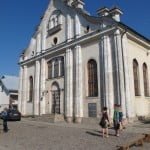
“White synagogue” built in 1885; former Yeshiva; former Jewish school. Remnant of Jewish cemetery (with memorial to the destroyed Jewish community).
The NGO Borderland Foundation uses the former Jewish sites as its premises. The Foundation carries out many projects to restore Jewish memory and culture as well as promote inter-ethnic understanding.
There is also a Jewish cemetery.
SŁAWATYCE
A web site organized by descendants, dedicated to the preservation of the Jewish cemetery and maintaining the memory of the Jewish community.
SOKOLOW PODLASKI
A web site and blog devoted to Jewish heritage and history in this town in east-central Poland, with photos and an interactive map of sites (both surviving sites and buildings as well as places with the destroyed synagogue, Jewish cemetery and other sites once stood).
Few heritage sites have been left intact, but the web site features an online Walking Tour of what remains.
SUSZ
The Rundbogenstil red brick synagogue in this small town in northern Poland, built in 1868, has been used as a culture center (and had signage outside giving ites history). As of 2019 it has been undergoing restoration to become the site of a Regional Museum.
Museum Facebook page (chronicling renovation)
Article about Jewish heritage in Susz
SZYDŁOWIEC
Jewish cemetery
ul. Wschodnia
Listed as a national heritage monument, the cemetery has about 3,000 stones, many highly decorated. According to the National Heritage Board, the gravestones from three Jewish cemeteries are located on the site: The oldest cemetery was established around 1788 and functioned until 1943. A second was founded nearby in 1811. A cholera cemetery was founded 1831 and as of 1918 was joined to the other cemeteries. In 1957, the oldest two cemeteries were closed down to make way for construction on their sites, and their gravestones were relocated to the current cemetery site. The oldest gravestone dates from 1831.
Synagogue
ul. Gabarska 3
The town’s synagogue was destroyed but a small private prayer house, built by the Ajzenburg family remains standing.
A sukkah dating from the 1920s and attached to a dwelling house was discovered in 2007 and in 2008 was disassembled, removed and turned over to the museum in nearby Radom for restoration.
Holocaust-era Photo Album from Szydlowiec
Yad Vashem has digitized a private photo album, possibly of a German policeman, that includes photos of gravestones in the Jewish cemetery, a synagogue, scenes from the Szydlowiec ghetto.
The Tale of Szydlowiec. Memory and Oblivion in a Former Shtetl in Poland.
An article by Barbara Törnquist-Plewa on the fate of post-Holocaust Jewish memory and heritage sites in Szydłowiec.
TARNÓW
Well-preserved and documented Jewish cemetery (currently undergoing extensive restoration); old Jewish quarter; former Jewish bathhouse. All that remains of the great synagogue is the four-pillared Bimah, which stands as a monument and memorial.
ul. Szpitalna
One of the oldest Jewish cemeteries in Poland, probably founded in the latter part of the 16th century. The oldest known gravestone is from 1688. There are around 3,000 gravestones. The site is listed as a historic cultural monument and is currently undergoing renovation.
Ongoing project to document and catalogue the Jewish cemetery
Prepared by the town’s Tourist Information Center, the trail provides online information on major Jewish sites — Bimah, Jewish street, cemetery, and more. (This site also works and provides the same information.)
Web site of the Committee for the Protection of Jewish Heritage in Tarnów
Founded in 1988 and affiliated with the Regional Museum, the Committee organizes and facilitates a number of cultural and educational activities and preservation projects in Tarnów and other nearby places. It received a major grant for the restoration of the Jewish cemetery. See Facebook page of the Committee.
Illustrated downloadable excerpt from Jewish Roots in Poland, by Miriam Weiner
Jewish cemetery on kirkuty (extensive information in Polish)
TYKOCIN
Synagogue Museum (Jewish section of District Museum of Bialystok)
Oddział Muzeum Podlaskiego w Białymstoku
ul. Kozia 2
16-080 Tykocin
Tel: +48 085 718 16 13
Fax: +48 085 718 16 26
Email: [email protected]
Housed since 1977 in the restored Great Synagogue (originally built in 1642); exhibition of Judaica with the main exhibit the restored synagogue itself.
Virtual tour of the synagogue and museum
WŁODAWA
Synagogue complex
Czerwonego Krzyża street

In southeastern Poland, on the Bug River, which forms the border with Belarus, the town has an important Synagogue Complex that includes the elegant late-baroque Great Synagogue, built in the late 18th century; a beit midrash originally built in the 18th century and reconstructed in the early 20th century; and a beit midrash from the 1920s.
The complex now houses the Leczna-Wlodawa Lake District Museum, mainly devoted to Jewish history and culture. A key feature is the colorful Ark in the Great Synagogue. The interior of the older beit midrash has been restored in a way that shows the damage it underwent during and after WW2.
Virtual Shtetl provides a detailed description of the Great Synagogue, which
was erected between 1764 and 1771 thanks to the efforts of the kehilla and support of the Czartoryski family foundation. Its design was most probably created by Paweł Antoni Fontana. The synagogue was partially rebuilt at the end of the 18th century. A hundred years later a second storey and two corner annexes were built. The interior was reconstructed after a fire had destroyed it in 1934. During the occupation the synagogue was devastated by the Nazis and changed into a storehouse. In such a condition it survived until 1970. In the 1980s it was thoroughly renovated and the Museum of Łęczna and Włodawa Lake District was opened there in 1986. A display of Judaica enriched the permanent ethnographic in 1990.
WROCŁAW
Active Jewish community, historic Jewish compound centered on the White Stork synagogue; two Jewish cemeteries. Before World War II, Wroclaw was the German city Breslau, which had the third largest Jewish community in Germany. The city’s Great Synagogue was destroyed on Kristallnacht, but in 2017 archaeologists revealed its foundations.
The comprehensive web site of an NGO launched in 2020, providing extensive information about Jewish heritage and history in Wroclaw/Breslau.
A comprehensive web site launched in 2021 that provides information on Jewish history and heritage in the city, from its origins until the present day. It is a project by Urszula Rybicka, implemented as part of the Artistic Scholarship of the President of Wroclaw, and is funded by the city of Wroclaw.
White Stork Synagogue & Jewish compound
Neoclassical synagogue, in a courtyard that is part of a Jewish communal complex. Built in 1827-29 and designed by Karl Ferdinand Langhans. Restored and rededicated in 2010, thanks largely to the efforts of the Bente Kahan Foundation. There is a permanent exhibition on Jewish history in the women’s gallery.
The Jewish compound also includes a historic Mikveh. Restoration of it began in 2017, to bring it back to its function as a ritual bath and also an exhibition space. There is also a small Beit Midrash, which also underwent recent renovation.
Jewish Cemeteries
Jewish Cemetery on ul. Lotnicza
Founded at the end of the 19th century, it was long overgrown but has undergrown recent restoration work and is still used by the Jewish community
Museum of Cemetery Art
Ślężna 37/39
Tel: +48 (0) 71 79 59 04 or 79159 03
Founded in 1856, it has about 12,000 gravestones and covers 4.6 hectares. It was listed as a national historic landmark in 1975 and since 1991 has been administered as a Museum of Cemetery Art that is part of the city museum. This cemetery has many elaborate tombsand is the final resting place of luminaries such as the socialist politician Ferdinand Lassalle (1825 – 1864), and the parents of the Jewish intellectural Edith Stein (who converted to Catholicism, became a nun, was killed at Auschwitz, and was proclaimed a saint by Pope John Paul II).
Carried out by the Institute of Architecture, Hochschule Mainz, the project presents the digital reconstruction along with extensive resources detailing how it was created, including illustrative material showing each component. It also provide information about the history of the synagogue and the work of its architect, Oppler, who built five grand synagogues — all of which were destroyed.
WRONKI
Jewish Cemeteries/Monument
The two Jewish cemeteries were destroyed by the Nazis and their stones were broken and used as paving. In 2011, about 500 fragments were recovered, and used to construct a memorial lapidarium in Wronki dedicated in 2014.
Facebook page of the Lapidarium
Photo documentation of the cemeteries and recovered stones before the lapidarium was built
Read blog posts describing the lapidarium by Marysia Galbraith HERE and HERE and HERE
See a video of the Lapidarium:
Imposing Renaissance synagogue in the heart of Zamość’s old town, used after World War II as a library. Restored as a project of the FODZ, which took ownership in 2005, with funding from the EEA and Norway Grants, the World Monuments Fund and others, it was rededicated and reopened in 2011 as the “Synagogue Center,” an information and culture center with an exhibition on Jewish history that is the anchor of the Chassidic Route tourism itinerary.
Other sites in town include: monument built of fragmentsof matzevot at the site of the Jewish cemetery (Prosta St.), which was destroyed in WW2. The synagoguein the New Town (32 Gminna St.) which was transformed for used as a a kindergarten and church. There is a former mikveh at In the former mikvah (3 Zamenhofa St.).
See World Monuments Fund pages about the Zamość synagogue and its restoration
PDF Brochure about the Synagogue and its Revitalization
Downloadable PDF brochure about Jewish history and sites in Zamość
Group of descendants of Jewish from Zamość and other towns in the vicinity, with photos, documents and other material, including on the synagogue
See a lecture by FODZ CEO Monika Krawczyk about the restoration of the Zamosc synagogue:
Before WW2, Jews made up the majority of the population in this small town in central Poland. Much of the Jewish built heritage of the town was destroyed, but much still remains: synagogue (now used as a culture center), the new Jewish cemetery, typical houses and shops. The Silesian Voyvoidship Authority and the local municipality have financed a Jewish Culture Trail, available online in both English and Polish, that takes in houses and shops, urban structure, the surviving synagogue, the surviving Jewish cemetery, the WW2 ghetto and provides historical details.