

 Artist, art historian. and Jewish heritage researcher Dr. Eugeny Kotlyar, a professor at the Kharkiv State Academy of Design and Arts, was forced to flee from Kharkiv to Lviv after Russian forces bombarded the city. In 2022 he wrote a powerful Have Your Say personal essay for us, in which he described his journey through Ukraine, which took him and his family through Jewish places he had researched and written about for years — former shtetls which had been home to historic Tzaddikim. Fordham University in New York is currently hosting an exhibition of photographs of one-time shtetls in western Ukraine that Kotlyar has taken over the past two decades.
He has authorized us to post a selection of photographs from the exhibit, as well as excerpts from a long article that he wrote for the exhibition catalogue.
(The cover photo above is titled Dialogue. At the Old Jewish Cemetery in Kuty. “Shtetl. Transgression” cycle. 2002-2024 © Eugeny Kotlyar.)
– – – – – –
The Ukrainian Shtetl: Homecoming to Places of Strength
Photographs and Text by Eugeny Kotlyar
July 9, 2024
At the turn of the last centuries, the light of the shtetl streamed in as a thin ray from a cobwebbed keyhole. Through the efforts of many researchers, the old rusty door to this lost world slowly began to open. But it was not easy to see its former glory. […]
The intricacy of streets, picturesque light shades of old local buildings with crumbling limed walls, ruined old synagogues, shuttered windows, carved steles of tombstones with strange and mysterious symbols…. This is what is left of that world.
This desolation is not a dumping ground for old things. It is a world still full of human warmth and deep mystical power. In this twenty-first century, this world has also become my place of power.


From my native Kharkiv in the east of the country, fate led me through unpredictable paths to these parts of western Ukraine. I first came here as a traveler more than twenty years ago, later I brought my relatives, friends, and students to these places, and organized scholarly expeditions and plenaries. Then, in March 2022, my family and I fled here, seeking refuge from Russian shelling. A year ago, these old sites brought me to their fully-developed living space, filled with holiness, prayer, and modern community life. It was already a new experience of pilgrimage to the realm of graves and the spirit of the great Hasidic tzaddikim.

Over the years I used a film camera, then digital, and finally a high-quality smartphone camera. I shot greedily, afraid of missing out on anything of value. The feeling that I would be the last to capture the still vanishing world of the shtetl became obsessive. The allure of old photographs mentally brought me back to this black and white world, and I clung to this style to free myself from modernity. Documentary stylization became my preference. I tried to enrich the image of the recorded subject, to poeticize it, using montages, softness or contrast, darkening of the frame and frames that refer to prints from old glass photographic plates.


The number and names of all the places I saw can no longer be remembered. In memory only their generalized portraits, strokes, images that flashed like people’s faces, the great and silent space of Yiddishland. The footage was included in several cycles of my existential photographic journeys, among them The Shtetl’s Chambers, Silence. Panoramas of Yiddishland, The Aesthetics of Desolation, Asymmetry of Time, Faces of Localities, and Shtetl. Transgression. They summarized my observations and emotions, my desire to enter this portal of the past, to wander through its labyrinths, to find through things, people, space, emptiness, symbols, and finally, light, my path of transcendence.
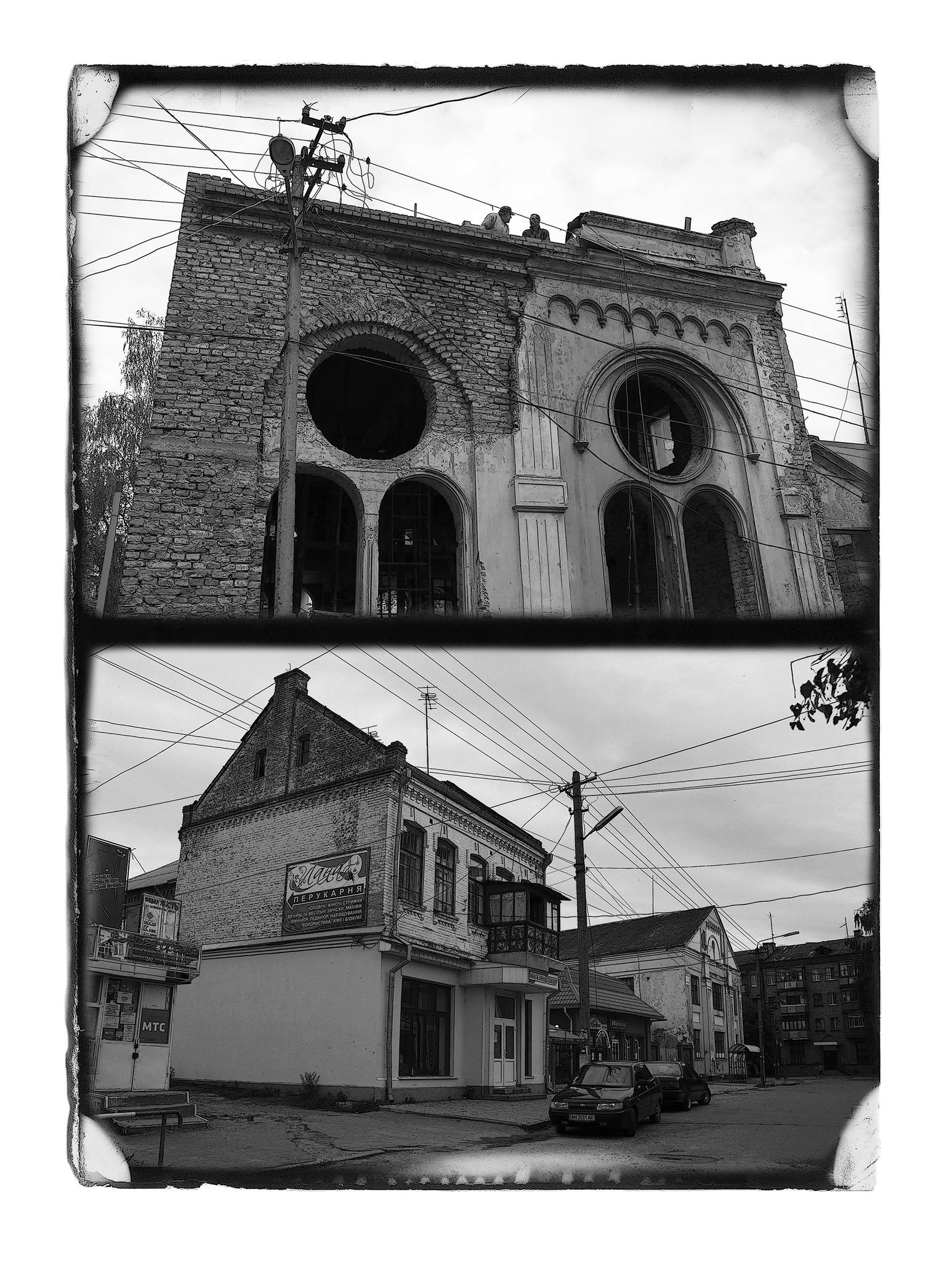
For two decades, I have been tracking the changing life of the Ukrainian province. Away from the bustling civilization, time flowed differently here, slowing down and stopping. With each new trip, I rediscovered familiar places, looked for changes, and listened to the exciting silence. My thoughts took me deep into the eras when the classic shtetl breathed its full breath, and when its breath was interrupted. But even in this space of the boundless power of the winds, I continue to feel the current of life and the lightness of my own breath.
I suddenly realized that neither I nor the generations to come will be the last witnesses of the shtetl. Slowly and steadily losing its authentic appearance, this space will reveal itself to contemporaries and descendants in a new way. In the age of digitalization, virtualization, and artificial intelligence, the technologies of the future will help us not to forget the past. So, the world of the shtetl will always be accessible to direct or indirect contact. It will always remain a place of deep longing, inexplicable love, and abiding power.
– – – – –

Dr. Eugeny Kotlyar is Professor of Art History and the Head of the Department of Monumental Painting of the Kharkiv State Academy of Design and Arts and chair of the Academic Board of the Ukrainian Association for Jewish Studies. The author of about 200 publications (articles, catalogs, books, and edited books), his main research areas include Jewish art, synagogue wall-painting decorations, and local Kharkiv Jewish history. Trained as an artist in monumental arts and as an art historian, he has participated as a designer and stained-glass artist to restore synagogues and Jewish community centers in many cities of Ukraine. He also created exhibitions in several Jewish museums, including the multimedia space of the Drobytsky Yar Memorial in Kharkiv.