
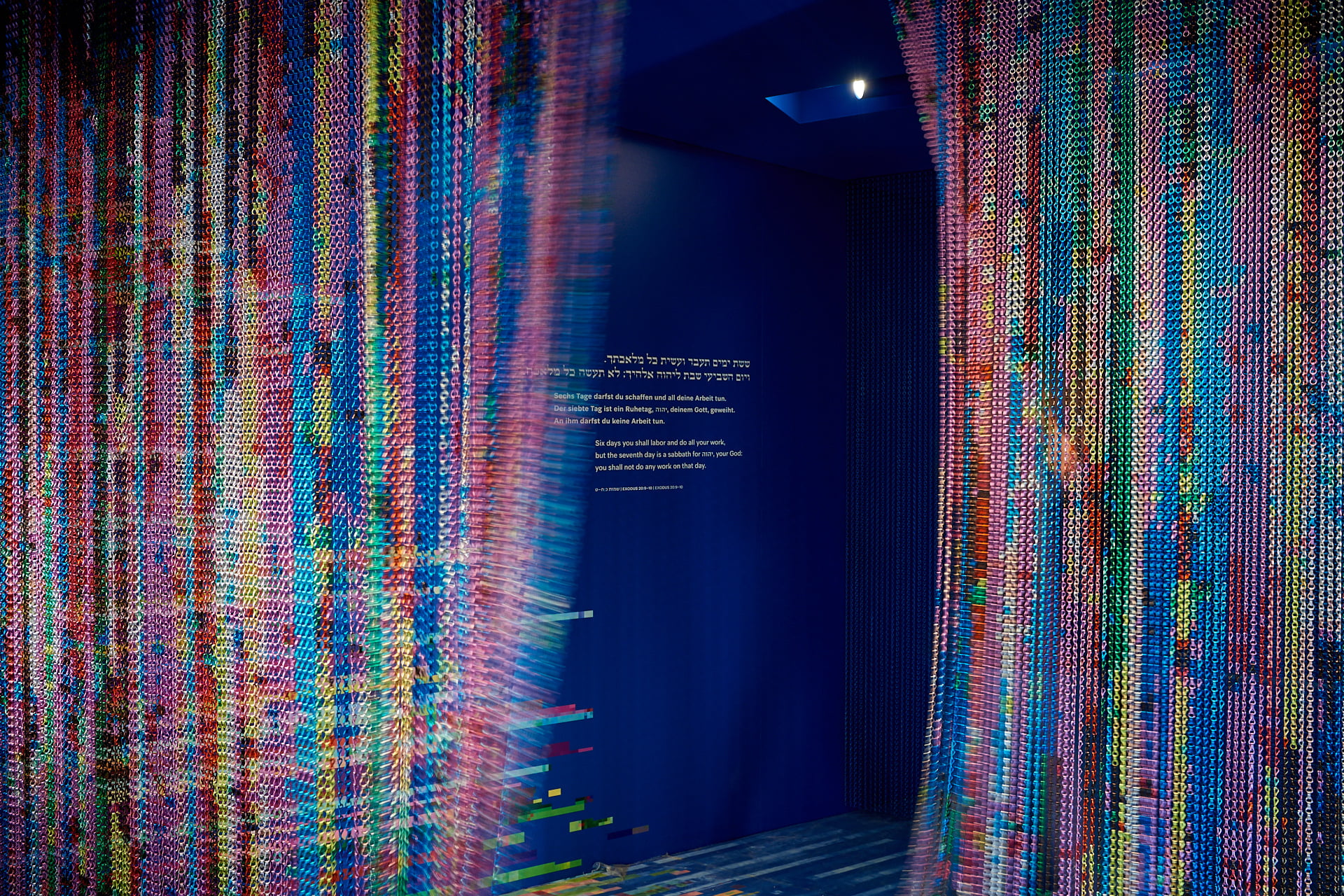
Mazel tov to the Berlin Jewish Museum, which has reopened with a totally revamped core exhibition that prioritizes Jewish life in Germany — including rebuilding Jewish life in the decades after the Shoah and then after the Berlin Wall came down — as well as Jewish history, art, traditions, and heritage.
Called Jewish Life in Germany: Past and Present, the new core exhibit reopened in the museum’s iconic, unconventional building designed by Daniel Libeskind on Sunday (August 23) after more than 2-1/2 years of development and reconstruction. A team of 20 experts developed the exhibit, whose guiding theme is to relate
from a Jewish perspective the history and culture of the Jews in Germany. It focuses on the relationship between Jews and their Christian, and increasingly secular, surrounding.
The exhibit is structured around five historical epochs — spanning the 1,700 years of Jewish presence in Germany, from the beginnings of Jewish life in Ashkenaz to the emancipation movement in the nineteenth century, through the violent destruction of Nazism to the varied voices of Jewish life today.

However, unlike the previous core exhibit (which ran from the Museum’s opening in 2011 until December 2017 and attracted 11 million visitors), the new exhibit is not organized strictly chronologically; in addition to five “epoch rooms” it also revolves around a number of themes and concepts, exploring how Jews lived — and live today — that are explored in eight thematic rooms.
“We are setting different accents than we did twenty years ago,” Cilly Kugelmann, chief curator of the exhibition, said in a statement. “We’re focusing more on the interaction of Jews with their non-Jewish environment and taking up more themes of Jewish culture and religion.”

Displays of more than 1,000 objects and art are complemented by video, sound, and interactive content, such as virtual reality and audio-visual media, art installations, interactive games, and hands-on stations. In one section, visitors can use VR glasses to “walk through” virtual recreations of synagogues that no longer exist.
Photos show the new design to have a clean, uncluttered look.
The path through the new exhibition alternates between historical epochs and insights into Jewish themes that cannot be described in geographical or chronological categories. What is sacred in Judaism? What is the significance of Shabbat? What is the sound of Judaism? Eight thematic islands invite visitors to explore Jewish culture and religion with all their senses. They can hear liturgical chanting, Purim noisemakers, and pop music, or listen to interviews to learn if, how, and why Jews today keep the commandments. The room-filling work by artist Anselm Kiefer, Shevirat ha-Kelim (Breaking of the Vessels), offers an interpretation of the myths of creation in the Lurianic Kabbalah.
One centerpiece is an interactive media installation called Family Albums, where visitors can explore the life stories of several generations by explored more than 500 documents and photographs, everyday items, and works of art from the bequests of ten families. Antisemitism, persecution, and anti-Jewish violence through the ages is also dealt with, both as a recurring theme and in a separate museum segment.

“The history of the Jews has not changed, but our perspectives on it have,” Hetty Berg, who took up the post of Museum director in April, in the height of the pandemic, said in a statement. “The new exhibition is our response to changing viewing conventions and visitor expectations, as well as a new state of research.”
Together with the launch of the new exhibit, the Museum launched a smartphone app that visitors can use onsite or at home, via audio guides, information, games, and short films in various languages, including interviews with artists, object donors, historical witnesses sharing first-hand experiences, and curators.
Click to read a detailed descriptive tour of the Core Exhibit
Click to see a list of exhibit facts and figures
Deutsche Welle article with a video in English of the new exhibition